The Story Behind the End Times: Introduction
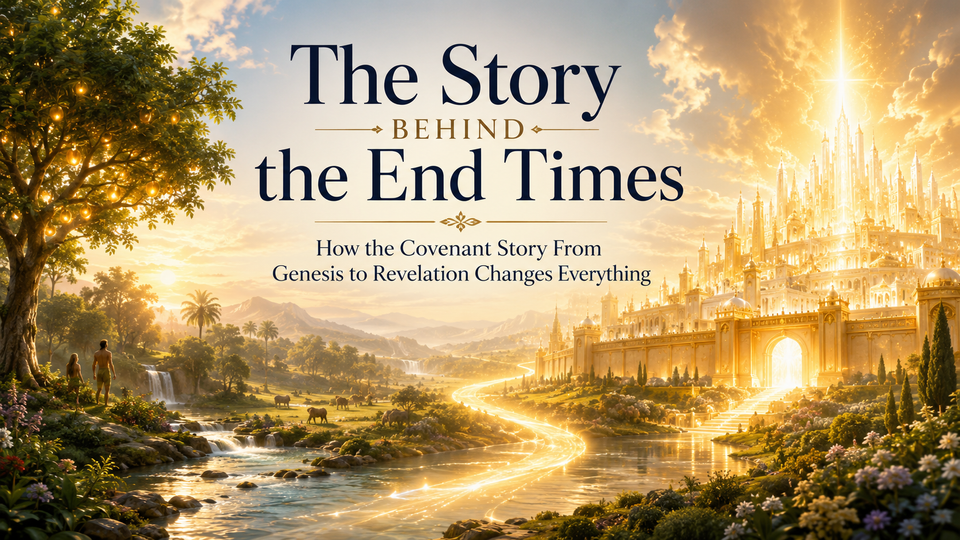
How the Covenant Story From Genesis to Revelation Changes Everything
Introduction:
From Eden to New Jerusalem
Something has felt wrong to many sincere readers of the Bible. Me included. They love Scripture, believe its message, and recognize Jesus Christ as the center of God’s redemptive purpose. Many have attended church for years, listened carefully to sermons, studied familiar prophetic passages, and tried to understand the different teachings about the end times. Yet beneath everything they have been told, they cannot escape the feeling that the popular explanation of Bible prophecy does not fit naturally within the larger story of Scripture.
They have often been taught that the Bible’s final message is primarily about the destruction of the planet, the collapse of modern civilization, a future world dictator, a rebuilt temple in Jerusalem, another system of animal sacrifices, and a brief period of worldwide terror unlike anything humanity has ever experienced. They have watched teachers interpret newspaper headlines as prophetic signs and modern nations as direct fulfillments of ancient biblical symbols. Revelation has been presented as a coded prediction of helicopters, nuclear weapons, computer chips, digital currency, international organizations, modern military alliances, and political leaders who lived nearly two thousand years after the book was written.
Yet an important question remains beneath all the charts, timelines, predictions, and speculation:
What did these Scriptures mean to the people who first received them?
What did the book of Revelation mean to the seven churches of Asia when it was read aloud in their congregations (Revelation 1:4, 11; 2:1–3:22)? What did Jesus mean when He warned the people standing before Him that judgment would come upon “this generation” (Matthew 23:34–36; 24:34)? What did Peter mean when he told first-century believers that “the end of all things is at hand” (1 Peter 4:7)? What did the writer of Hebrews mean when he said that the old covenant was growing old and was “ready to vanish away” (Hebrews 8:13)?
Were the biblical writers speaking clearly to real people who were facing real events, or were they primarily describing a distant world that their original hearers could never have imagined? Were words such as “near,” “soon,” “at hand,” and “this generation” intended to communicate something meaningful, or were they prophetic expressions that could stretch across thousands of years (Matthew 24:34; Romans 13:11–12; Philippians 4:5; James 5:8–9; Revelation 1:1, 3; 22:6, 10, 12, 20)?
The problem may not be with Scripture. The problem may be with the story we have been taught to place over Scripture.
The Bible Is One Story
The Bible does not begin with the Antichrist, the Great Tribulation, or the destruction of the physical universe. It begins with God creating a world in which He intends to dwell with humanity. It begins with a garden filled with life, light, water, fruitfulness, sacred space, human purpose, and the presence of God (Genesis 1:1–2:25). Humanity is created in the image of God and commissioned to fill the earth, exercise wise dominion, cultivate creation, and carry the glory of God outward into the world (Genesis 1:26–28; 2:15).
Before Scripture says anything about the last days, it first reveals the purpose toward which the entire story is moving. God desires to dwell with His image-bearing people in a creation filled with His life and glory (Genesis 1:26–28; Exodus 25:8; Leviticus 26:11–12; Habakkuk 2:14; Revelation 21:3).
The final chapters of Revelation return to the same images found in the opening chapters of Genesis. Revelation closes with a garden-city, the river of life, the tree of life, the removal of the curse, the healing of the nations, the servants of God reigning, and God dwelling with His people (Revelation 21:1–5; 22:1–5). The story that began with humanity being driven from the presence of God ends with the declaration, “Behold, the dwelling place of God is with man” (Genesis 3:22–24; Revelation 21:3).
That connection is not accidental.
Genesis and Revelation form the two great bookends of the biblical story. What was lost in Adam is restored and greatly surpassed in Christ (Romans 5:12–21; 1 Corinthians 15:21–22, 45–49). What began in a garden is completed in a city. What was once limited to one sacred place expands until the presence and glory of God fill the whole creation (Isaiah 11:9; Habakkuk 2:14; Revelation 21:22–24). Humanity is not merely returned to Adam’s original condition. In Christ, humanity is brought into something greater, deeper, and more secure than what existed at the beginning (Ephesians 1:3–10; 2:4–7; Colossians 1:12–20).
Old Testament scholar T. Desmond Alexander describes the movement of Scripture as a “fascinating and coherent progression from Eden to tabernacle to Jerusalem temple to church to New Jerusalem.”[1] This progression gives us the basic direction of the biblical story. Scripture moves from creation to new creation, from Adam to Christ, from exile to restoration, from shadow to substance, from the old covenant to the New Covenant, and from the guarded tree of life to the tree whose leaves bring healing to the nations (Genesis 3:24; Colossians 2:16–17; Hebrews 8:6–13; Revelation 22:2).
The Bible is not a collection of disconnected religious writings. It is one unfolding story of creation, covenant, rebellion, judgment, redemption, restoration, and divine presence. Every major section of Scripture contributes to this story. The covenants, the Law, the priesthood, the sacrifices, the land, the temple, the kingdom, the exile, the prophets, the Messiah, the cross, the resurrection, the outpouring of the Spirit, and the New Jerusalem all belong to one unified purpose (Luke 24:25–27, 44–47; Acts 3:18–24; Ephesians 1:9–10).
If we misunderstand the story, we will almost certainly misunderstand its ending.
Covenant Is the Backbone of the Biblical Story
One of the most important words in the Bible is also one of the least understood: covenant.
A covenant is more than a casual agreement between two people. It is not merely a contract in which each party promises to exchange certain goods or services. Contracts generally concern property, labor, or business arrangements. Covenants concern relationships, identity, loyalty, belonging, inheritance, and life itself. A covenant establishes promises, responsibilities, privileges, consequences, and the nature of the relationship between those who enter it.
Old Testament theologian O. Palmer Robertson famously defined a covenant as “a bond in blood sovereignly administered.”[2] His definition emphasizes the seriousness of covenant. Biblical covenants are not temporary understandings that can be ignored without consequence. They concern life and death, blessing and curse, faithfulness and judgment (Genesis 2:16–17; 15:7–21; Exodus 24:3–8; Deuteronomy 28:1–68; 30:15–20).
New Testament scholar Thomas Schreiner describes the biblical covenants as “the backbone of the biblical story.”[3] This is not an exaggeration. The storyline of Scripture is carried forward through God’s covenant dealings with Adam, Noah, Abraham, Israel, David, and ultimately through the New Covenant established by Jesus Christ (Genesis 2:15–17; 6:18; 9:8–17; 15:1–21; 17:1–14; Exodus 19:3–8; 24:3–8; 2 Samuel 7:8–16; Jeremiah 31:31–34; Luke 22:20).
Covenant explains why God called Abraham and promised to bless all the families of the earth through his Seed (Genesis 12:1–3; 15:1–21; 17:1–8; 22:15–18; Galatians 3:8, 16). Covenant explains the Exodus, because God remembered His covenant and delivered Israel from slavery (Exodus 2:23–25; 6:2–8). Covenant explains the giving of the Law, Israel’s identity as a kingdom of priests, and the nation’s inheritance in the land (Exodus 19:4–6; 24:3–8; Deuteronomy 4:5–8; Joshua 21:43–45).
Covenant explains the tabernacle, temple, priesthood, sacrifices, feasts, and holy days (Exodus 25:8–9; 29:42–46; Leviticus 1:1–7:38; 23:1–44; 1 Kings 8:1–21). Covenant explains the blessings Israel enjoyed when it walked in faithfulness and the curses it experienced when it rebelled (Leviticus 26:1–46; Deuteronomy 28:1–68).
Covenant also explains Israel’s exile. The nation was not driven from the land because God had forgotten His promises. Israel was exiled because the covenant itself warned that persistent rebellion would bring judgment, scattering, and removal from the land (Leviticus 26:27–39; Deuteronomy 28:36–37, 49–68; 2 Kings 17:7–23; 25:1–21). The prophets did not appear suddenly with unrelated messages of doom. They came as covenant messengers, calling Israel back to faithfulness, announcing covenant judgment, and promising covenant restoration through the coming Messiah (Isaiah 1:2–20; Jeremiah 2:1–13; 11:1–17; Hosea 4:1–10; Malachi 3:1–5).
Covenant explains the ministry of John the Baptist, who prepared Israel for the arrival of its King and warned that judgment was already approaching (Matthew 3:1–12; Luke 3:3–17). Covenant explains Jesus’ conflict with the religious leaders, His announcement of the kingdom, His identification with Israel, and His warnings concerning the temple and Jerusalem (Matthew 4:17; 12:1–14; 21:33–46; 23:29–38; 24:1–2).
Covenant explains the cross, where Christ bore the curse and established the New Covenant in His blood (Deuteronomy 21:22–23; Galatians 3:10–14; Luke 22:20; 1 Corinthians 11:25). Covenant explains Pentecost, the gathering of the nations, the creation of one new humanity in Christ, and the end of the old covenant order (Acts 2:1–39; 15:13–18; Ephesians 2:11–22; Hebrews 8:6–13).
Covenant also provides the framework through which Revelation must be understood. Revelation’s judgments are covenant judgments. Its promises are covenant promises. Its language of marriage, adultery, faithfulness, inheritance, sonship, priesthood, kingdom, blessing, curse, temple, and city all grows from the soil of covenant (Exodus 19:5–6; Deuteronomy 28:15–68; Isaiah 1:21; Jeremiah 3:1–14; Ezekiel 16:1–63; Revelation 1:5–6; 17:1–6; 19:6–9; 21:2–3).
Biblical eschatology cannot be separated from biblical covenant.
Eschatology Means the Last Things, but the Last Things of What?
The word eschatology comes from Greek terms referring to the study of the last things. Most Christians hear the phrase “last things” and immediately think of the end of the planet, the end of human history, or the destruction of the physical universe. That conclusion, however, cannot simply be assumed.
Whenever the Bible speaks about an end, we must ask a basic question:
The end of what?
Is the passage speaking about the end of a city, a nation, a kingdom, an age, a covenant administration, a temple order, or the physical universe itself? Is it describing the end of Israel’s long period of waiting, the end of the Mosaic age, the end of death’s dominion in Adam, or the completion of God’s redemptive purpose in Christ?
These ideas are not interchangeable.
The Bible frequently uses the language of an “end” for events that did not involve the disappearance of the planet. Ezekiel announced that an “end” had come upon the land of Israel (Ezekiel 7:2–6). Daniel spoke about the “time of the end” in connection with events involving his own people and their covenant history (Daniel 8:17–19; 11:35, 40; 12:1–9). Paul told the Corinthian believers that “the ends of the ages” had come upon them (1 Corinthians 10:11). Peter declared that Christ had appeared “in these last times” (1 Peter 1:20). The writer of Hebrews said that Jesus appeared “at the end of the ages” to put away sin through His sacrifice (Hebrews 9:26).
The apostles did not believe they were living near the end of the physical universe. They believed they were living at the climax of Israel’s covenant history. Peter declared that the outpouring of the Spirit at Pentecost was taking place in “the last days” foretold by Joel (Acts 2:16–21). Paul said that the fullness of time had arrived when God sent forth His Son (Galatians 4:4). Hebrews said that God had spoken through His Son “in these last days” (Hebrews 1:1–2).
The arrival of Jesus was not merely another event within the old age. His coming brought the ages to their appointed goal. In Him, the promises given to the fathers were reaching their fulfillment (Luke 1:68–75; Acts 13:32–33; Romans 15:8). The Messiah had come, the kingdom had drawn near, the New Covenant had been established, the Spirit had been poured out, and the nations were being gathered into the family of Abraham through faith (Mark 1:14–15; Luke 22:20; Acts 2:14–39; Galatians 3:7–9, 26–29).
The old covenant order, however, was still visibly standing. The temple continued to operate. The priesthood continued to serve. Animal sacrifices were still being offered. Jerusalem remained the center of the old religious world. The New Covenant had been established through Christ’s death, resurrection, and the outpouring of the Spirit, but the old order had not yet been publicly and historically removed (Acts 6:7; 21:20–26; Hebrews 8:13; 10:1–18).
The question was no longer whether the promised age would come. The question was how the old age would finally give way to the new.
Why the Old Testament Must Teach Us How Prophecy Speaks
Many end-time misunderstandings begin because readers enter Matthew 24, 2 Peter 3, or Revelation without first learning the language of the Old Testament prophets. They encounter a darkened sun, a blood-red moon, falling stars, shaking heavens, melting mountains, roaring seas, burning land, and clouds of divine judgment (Matthew 24:29–30; Acts 2:19–20; 2 Peter 3:10–13; Revelation 6:12–17). Because the language sounds cosmic, they assume that it must describe the literal destruction of the physical universe.
But this is not how the prophets consistently used those images.
Isaiah described the sun, moon, and stars going dark when he prophesied the fall of Babylon (Isaiah 13:1, 9–13, 17–22). He used the language of collapsing heavens in connection with the judgment of Edom (Isaiah 34:1–5). Jeremiah portrayed the approaching destruction of Judah as creation returning to a formless and empty condition (Jeremiah 4:23–28). Ezekiel described the downfall of Egypt’s ruler through the darkening of the heavenly lights (Ezekiel 32:2, 7–8). Joel used cosmic signs when warning Jerusalem about an approaching Day of the Lord (Joel 2:1–11, 30–31).
The physical universe did not disappear when those judgments occurred. The prophetic language communicated the theological, political, and covenantal importance of historical events. The fall of an empire or the destruction of a covenant nation was not a minor political adjustment. It was the collapse of an ordered world beneath the judgment of God.
N. T. Wright observes that biblical apocalyptic language was “precisely not about ‘the end of the world’ in the modern sense.”[4] He explains that Isaiah’s language concerning a darkened sun and falling stars referred to Babylon’s fall, while Jeremiah’s language of creation becoming formless and empty described the devastation of Jerusalem and its surrounding land.
Recognizing symbolic or metaphorical language does not make the prophecy less real. Metaphorical language can describe concrete historical events with tremendous force. When we say that an empire fell, a nation was shaken, or a person’s world came crashing down, we are not denying that something real happened. We are using physical images to communicate the magnitude and significance of the event.
Prophetic language works in much the same way, though with far greater theological depth. God is the Creator of heaven and earth. Nations, kings, cities, temples, and covenant orders exist beneath His authority (Psalm 2:1–12; 24:1; Daniel 2:20–21; 4:17, 34–35). When God judges a kingdom, the prophets portray that judgment as the shaking of its heavens and earth (Isaiah 13:13; Haggai 2:6–7, 21–22). When kings and rulers fall, their sun, moon, and stars are darkened (Isaiah 13:10; Ezekiel 32:7–8). When a covenant people return to chaos through rebellion, their land is described as becoming formless and empty (Jeremiah 4:23). When God restores His people, the prophets speak of resurrection, a new Exodus, a renewed creation, and new heavens and a new earth (Isaiah 11:10–16; 43:16–21; 65:17–25; Ezekiel 37:1–14).
Before we decide what this language means in the New Testament, we must learn what it already meant in the Old Testament.
Eden, Tabernacle, Temple, Christ, and New Creation
The connection between Genesis and Revelation becomes even clearer when we follow the theme of God’s dwelling place.
The Garden of Eden was more than a beautiful natural environment. It functioned as the first sacred space, the place where God dwelled with humanity (Genesis 2:8–15; 3:8). Adam was placed in the garden to “work” and “keep” it, words that were later used to describe the service and guardianship of Israel’s priests (Genesis 2:15; Numbers 3:7–8; 8:25–26; 18:5–6). Adam was not merely a gardener. He was an image-bearer, a royal servant, and a priestly guardian of the place where heaven and earth met.
After humanity’s rebellion, Adam and Eve were expelled from the garden. Cherubim guarded the way to the tree of life (Genesis 3:22–24). Humanity’s exile from Eden became the pattern for later covenant exile. Sin brought separation from sacred space, loss of inheritance, and removal from the place of God’s manifested presence (Leviticus 26:31–39; 2 Kings 17:18–23; 25:8–21).
The tabernacle and temple intentionally echoed Eden. They contained garden imagery, trees, flowers, fruit, precious stones, gold, cherubim, lamp light, sacred boundaries, and a central place of divine presence (Exodus 25:10–40; 26:1, 31; 28:9–21; 1 Kings 6:18–35; 7:18–22). The temple represented God dwelling among His covenant people, and the priesthood guarded access to that sacred presence (Exodus 25:8; 29:42–46; Leviticus 16:1–34; Numbers 18:1–7).
G. K. Beale describes Israel’s tabernacle and temple as “an organic development of the earlier garden sanctuary in Eden.”[5] The temple was not an unrelated religious building placed into the story centuries later. It carried the Eden pattern forward. It served as a symbolic world, a place where heaven and earth met, God dwelled among His people, and humanity’s original priestly calling was partially restored.
Yet the physical temple was never the final goal.
Jesus identified His own body as the true temple (John 2:19–21). John declared that the eternal Word became flesh and “tabernacled” among humanity (John 1:14). The glory that once filled the sanctuary was now revealed in the face of Jesus Christ (John 1:14–18; 2 Corinthians 4:6). God’s presence was no longer centered in a building made with human hands. It was embodied in the Son (Colossians 1:19; 2:9).
Through union with Christ, His people also became God’s temple. Paul told individual believers and gathered congregations that they were the dwelling place of the Holy Spirit (1 Corinthians 3:16–17; 6:19–20; 2 Corinthians 6:16). He described Jews and Gentiles together as a holy temple and dwelling place of God through the Spirit (Ephesians 2:19–22). Peter described Christians as living stones being built into a spiritual house and a holy priesthood (1 Peter 2:4–5, 9).
The church was not presented as a temporary interruption in God’s covenant purposes. It was the community created in and through the true Temple, Jesus Christ.
The movement of the story is clear:
Eden, tabernacle, temple, Christ, His covenant people, New Jerusalem.
Revelation does not end with humanity returning to an animal-sacrifice system in an earthly temple. It ends with God and the Lamb as the temple, the saints as a priestly people, and the entire city filled with divine presence (Revelation 21:2–3, 9–11, 22–23; 22:3–5). The final vision is not a retreat from the purpose announced in Genesis. It is the fulfillment of that purpose in Christ. By contrast, many futurist interpreters insist that a literal temple must yet be rebuilt in Jerusalem as part of end-time prophecy. For example, John F. Walvoord writes, “The most natural interpretation of the prophecies is that there will be a literal temple in Jerusalem in the end times, rebuilt on the ancient site and functioning during the tribulation period.”
Reading Revelation Backward Through the Headlines

Popular futurism often reverses the proper direction of biblical interpretation. Instead of beginning with Genesis, the Law, the Prophets, the teachings of Jesus, and the historical world of the apostles, it begins with modern events and searches Scripture for images that appear to correspond with them.
A military helicopter may become a locust from the abyss. A barcode, credit card, microchip, digital identification system, or form of electronic currency may become the mark of the beast. A modern political alliance may become the ten horns. Russia may become Gog and Magog. The European Union may become a restored Roman Empire. A modern national leader may be identified as the Antichrist.
As technology and politics change, the interpretations change with them.
This method has produced countless failed predictions. More importantly, it removes biblical symbols from the scriptural world that gave those symbols their meaning. Revelation becomes a blank prophetic canvas upon which each generation paints its own fears.
The first readers of Revelation knew nothing about helicopters, nuclear missiles, computer databases, biometric identification, modern nation-states, or international financial systems. They did, however, know the Old Testament. They knew the plagues of Egypt (Exodus 7:14–12:32; Revelation 8:6–9:21; 16:1–21), the covenant curses of Deuteronomy (Deuteronomy 28:15–68), the beasts of Daniel (Daniel 7:1–28; Revelation 13:1–18), the harlot imagery of the prophets (Isaiah 1:21; Jeremiah 2:20; Ezekiel 16:15–43; Revelation 17:1–6), and the arrogance of Babylon (Isaiah 13–14; Jeremiah 50–51; Revelation 17–18).
They understood the temple, altar, priesthood, lampstands, incense, trumpets, bowls, sacrifices, and the Song of Moses (Exodus 25:31–40; 30:1–10; Leviticus 4:1–7; Numbers 10:1–10; Deuteronomy 32:1–43; Revelation 1:12–13; 5:8; 8:2–5; 15:2–4; 16:1). They knew the language of marriage covenant, adultery, exile, restoration, and the promised New Jerusalem (Isaiah 54:1–8; 62:1–5; Jeremiah 3:1–14; Ezekiel 16:1–63; Revelation 19:6–9; 21:1–10).
Revelation contains relatively few formal quotations from the Old Testament, but its visions are woven from hundreds of Old Testament images and allusions, often estimated at well over 400 references or echoes. Its language is not a secret code pointing primarily to modern technology. It is the culmination of the Bible’s covenant vocabulary.
Revelation must be read forward from Genesis, not backward from the morning news.
Five Commitments for This Study
This book will follow five basic commitments that will guide our interpretation from Genesis to Revelation.
The first commitment is that Scripture must interpret Scripture. Later biblical writers build upon earlier revelation. The New Testament does not erase the Old Testament context or replace it with an entirely different story. It reveals how the promises, patterns, institutions, and symbols of the Old Testament find their goal in Jesus Christ (Matthew 5:17–18; Luke 24:25–27, 44–47; 2 Corinthians 1:20; Colossians 2:16–17).
The second commitment is that the original audience matters. Biblical books were written for us, but they were not originally written to us. Revelation was addressed to seven real churches in Asia (Revelation 1:4, 11). Jesus spoke His warnings to real disciples living in the first century (Matthew 24:1–3, 15–34). Paul, Peter, James, John, and the writer of Hebrews addressed real congregations experiencing real struggles and expectations.
An interpretation that makes a biblical text meaningful to modern readers but nearly meaningless to its first audience should immediately be questioned.
The third commitment is that covenant provides the historical framework of prophecy. The prophets did not speak in a vacuum. They ministered within Israel’s covenant story. They warned of covenant curses, called the people to repentance, announced approaching judgment, and promised restoration through the Messiah (Deuteronomy 28:15–68; Isaiah 1:2–20; Jeremiah 11:1–17; Hosea 6:1–7; Malachi 3:1–5).
The fourth commitment is that prophetic imagery must be read according to its established biblical use. We will not assume that every reference to fire, clouds, cosmic darkness, shaking heavens, or the coming of God describes the destruction of the material universe. We will examine how Scripture itself uses those expressions before deciding what they mean in later passages (Psalm 18:7–15; Isaiah 13:9–13; 19:1; 34:4–5; Micah 1:3–6).
The fifth commitment is that the Bible’s time statements deserve to be honored. Words such as “near,” “soon,” “at hand,” “this generation,” and “a little while” cannot be treated as meaningless decorations (Matthew 10:23; 16:27–28; 24:34; Romans 13:11–12; Hebrews 10:37; James 5:8–9; Revelation 1:1, 3; 22:6, 10, 12, 20). Audience relevance and temporal expectation are part of the inspired message.
We must not force every prophecy into the first century merely because it contains a time statement. Neither may we push clear first-century expectations thousands of years into the future simply because they conflict with an inherited theological system.
What This Book Is Not
This book is not an attempt to remove hope from Christianity. It is not an argument that God no longer acts in history, that evil does not matter, that physical death is insignificant, or that the kingdom of God has no continuing growth and manifestation in the world.
It is also not an argument that every Christian scholar has always agreed about prophecy. The scholars quoted throughout this work come from different theological traditions, and they do not all share the same conclusions. Their value lies partly in that diversity.
Many scholars who do not identify as preterists nevertheless recognize that Eden functioned as sacred space, that the temple reflected Eden, that covenant structures the biblical story, that prophetic cosmic language often described historical judgments, that Jesus announced judgment upon first-century Jerusalem, and that Revelation is saturated with Old Testament imagery. This book will bring those widely recognized pieces together and ask where the biblical storyline itself leads.
This study is not written merely to win an argument. Eschatology affects how we understand God, the gospel, the church, the kingdom, and our place in the world. A theology that leaves the church constantly waiting for defeat, evacuation, and global collapse will produce different fruit from one that announces Christ’s present reign, the power of the New Covenant, and the continuing expansion of His life among the nations (Psalm 110:1–2; Isaiah 9:6–7; Daniel 7:13–14; Matthew 28:18–20; 1 Corinthians 15:25).
In many conversations about the end times, I have personally observed this difference in fruit. When brothers speak from a framework that expects the church to ultimately fail, their tone often carries little hope, only a sense of inevitable decline, retreat, and loss. Instead of confidence in Christ’s victory, there is a quiet expectation that darkness will prevail until the church is removed. Yet Jesus declared that He would build His church and that the gates of hell would not prevail against it (Matthew 16:18). What I often hear and feel in these discussions seems to reflect the opposite, a vision not of advancing light, but of a church overcome. This tension is not merely theoretical, it shapes how we live, how we pray, and how we expect God to work in the world today.
The central question is not merely, “When do the end-time events happen?”
The deeper question is, “What was God bringing to completion in Jesus Christ?”
The Road From Eden
We will begin where the Bible begins. We will enter the garden and examine humanity’s original calling. We will follow the covenant storyline through Adam, Noah, Abraham, Moses, Israel, David, exile, and prophetic restoration. We will learn the language of covenant blessing and covenant curse. We will examine what the prophets meant by the Day of the Lord, the shaking of heaven and earth, resurrection, new creation, and the coming of God upon the clouds.
Then we will come to Jesus.
We will listen to John the Baptist announce that the axe was already laid at the root of the trees. We will hear Jesus proclaim the kingdom, identify Himself as the true temple, confront Israel’s covenant leaders, and warn Jerusalem of approaching desolation. We will follow the apostles as they announce the last days, the end of the ages, the arrival of the New Covenant, and the creation of one new humanity in Christ.
Finally, we will enter Revelation, not as strangers entering a maze of unfamiliar codes, but as readers who have learned its language from the rest of the Bible.
There we will find Genesis again. We will find the serpent and the promised Seed. We will find creation and Exodus, the wilderness and Babylon, the temple and priesthood, the kings and prophets. We will find the faithful Bride and the unfaithful harlot. We will find covenant judgment and covenant vindication. We will find the river of life, the tree of life, and a city in which no physical temple is needed because God and the Lamb are its temple.
We will find the curse removed, the nations healing, and the servants of God reigning (Revelation 22:2–5).
The Bible begins with God dwelling with humanity in a garden. It ends with humanity dwelling with God in a garden-city. The story is covenantal from beginning to end.
To understand its ending, we must return to its beginning.
Notes to the Introduction
[1] T. Desmond Alexander, From Eden to the New Jerusalem: Exploring God’s Plan for Life on Earth (Grand Rapids: Kregel Academic, 2009), 73.
[2] O. Palmer Robertson, The Christ of the Covenants (Phillipsburg, NJ: Presbyterian and Reformed Publishing, 1980), 4.
[3] Thomas R. Schreiner, “10 Things You Should Know about the Biblical Covenants,” Crossway, July 17, 2017.
[4] N. T. Wright, “Space, Time and History: Jesus and the Challenge of God,” 2019.
[5] G. K. Beale, “Adam as the First Priest in Eden as the Garden Temple,” The Southern Baptist Journal of Theology 22, no. 2 (2018): 19.
If these messages have encouraged you, like, comment and subscribe. Please consider planting a seed. Your generosity helps continue this work and creates opportunities for others to grow and strengthen their faith.

Member discussion