No More Sting
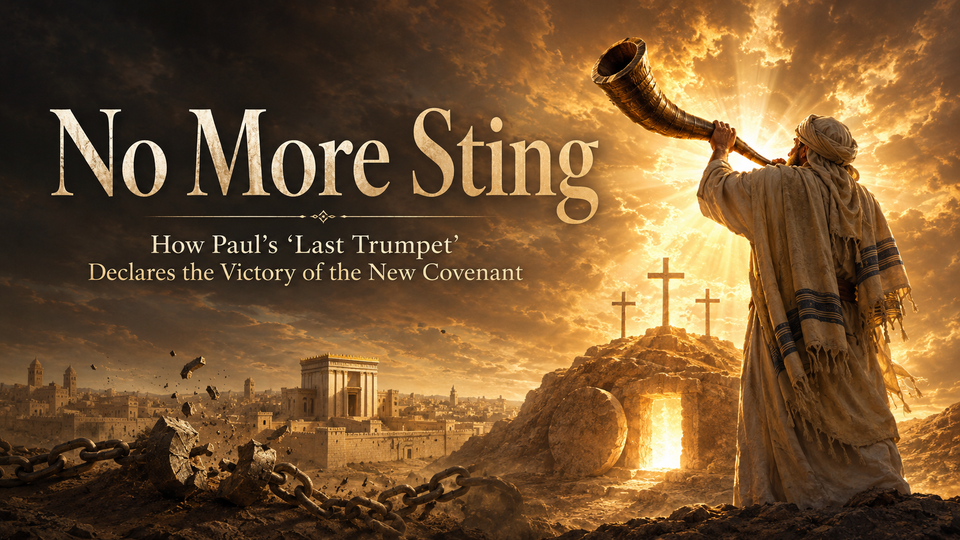
HOW PAUL’S “LAST TRUMPET” DECLARES THE VICTORY OF THE NEW COVENANT
One of the most powerful things Paul ever wrote is found in 1 Corinthians 15, but I think it is also one of the most misunderstood. Most of us were taught to read this passage through the lens of a future end-of-the-world rapture, where graves explode, bodies fly upward, and the last trumpet becomes the final sound before planet earth is evacuated. But when Paul gets to the climax of his argument, he does something very important. He tells us exactly what kind of victory he is talking about.
He says, “Death is swallowed up in victory. O death, where is your sting? O grave, where is your victory?” Then he immediately explains,
“The sting of death is sin, and the strength of sin is the law” (1 Corinthians 15:54–56)
That sentence matters.
Paul does not say, “The sting of death is that your physical body stops breathing.” He does not say, “The strength of death is biology.” He says the sting of death is sin, and the strength of sin is the law. So right away, Paul is not merely talking about physical death as a natural event. He is talking about death as a covenantal power. He is talking about death as condemnation. Death as separation. Death as the reign of Adam. Death as the curse. Death as the old creation order where sin ruled, the Law exposed guilt, and man stood condemned outside the fullness of life in God.
That does not mean physical death is meaningless. Of course not. We still grieve when people die. We still stand at gravesides. We still feel the ache of loss. Paul himself never treated death casually. But his point is that in Christ, death has lost its sting. The grave no longer has the final word. The Law no longer stands over God’s people as a ministry of condemnation. Sin no longer has legal dominion over those who are in Christ. The old Adamic order has been overcome by the resurrected Son of God.
This is why 1 Corinthians 15 is not just about bodies. It is about two humanities. Adam and Christ. The first man and the last Adam. The natural man and the spiritual man. The old creation and the new creation. Paul says,
“As in Adam all die, even so in Christ shall all be made alive” (1 Corinthians 15:22)
That is the whole framework. Adam brought humanity into sin, exile, corruption, and death. Christ brings His people into righteousness, restoration, incorruption, and life.
So when Paul says the last trumpet sounds and the dead are raised incorruptible, he is not giving us a Hollywood rapture scene. He is announcing the climactic victory of Christ over the covenant world of Adam, sin, death, and Law. The trumpet is royal. It is covenantal. It announces the victory of the King and the arrival of the completed New Covenant order.
And this is where we need to slow down and let Paul be Paul.
He quotes from the Old Testament when he says, “Death is swallowed up in victory.” That language comes from Isaiah 25, where God promises to swallow up death, wipe away tears, remove reproach, and prepare a feast for His people. This is not random end-times language. It is covenant restoration language. It is the promise that God would remove the veil, defeat the shame of His people, and bring them into the joy of His salvation.
Then Paul echoes Hosea 13 when he says, “O death, where is your sting? O grave, where is your victory?” Hosea is dealing with covenant judgment, exile, and restoration. Again, Paul is not pulling verses out of nowhere. He is showing that the promises of Israel’s restoration, the defeat of death, and the removal of covenant shame all come to their fullness in Christ.
And then he gives the key: “The sting of death is sin, and the strength of sin is the law.”
That one line should change how we read the whole passage.
If the sting of death is sin, then the victory over death must involve the removal of sin’s condemning power. If the strength of sin is the Law, then the victory over death must involve the end of the Law’s covenantal ministry of condemnation. This is exactly what Paul teaches everywhere else. In Romans 7, he says sin took opportunity through the commandment and produced death in him. In Romans 8, he says there is now no condemnation for those who are in Christ Jesus. In 2 Corinthians 3, he calls the old covenant the ministry of death and condemnation, and he contrasts it with the ministry of the Spirit and righteousness.
So let’s say it plainly: the death Paul is celebrating victory over is not merely physical death. It is covenantal death under Adam, sin, and Law. It is the death that kept man under condemnation, outside the fullness of life, and bound to the old creation order. And Christ swallowed that death up in victory.
That is why this passage is so much bigger than a future escape plan.
The resurrection of Jesus was not just proof that one day bodies will come out of the ground. It was the beginning of a new creation. It was the enthronement of the last Adam. It was the declaration that the old world of sin, death, Law, temple, sacrifice, and separation was passing away, and the new world of righteousness, Spirit, access, and life had arrived in Him.
This is also why Paul says,
“We shall not all sleep, but we shall all be changed” (1 Corinthians 15:51)
He was speaking to a first-century people living in the transition between the old covenant age and the fully revealed New Covenant age. Some would die before that transition was complete. Some would remain alive. But all who belonged to Christ would share in the same covenantal transformation. The dead in Christ were not left behind in Hades. The living in Christ were not second-class citizens. Together, they were brought into the fullness of resurrection life in the completed kingdom of Christ.
That is the hope.
Not escapism. Not charts. Not panic. Not a secret disappearance. The hope is that Christ has conquered the very thing that held mankind in bondage. He defeated sin. He fulfilled the Law. He removed condemnation. He opened the way into the presence of God. He brought life and immortality to light through the gospel. And yet, when I hear voices saying,
—Quotes taken from different futurist YouTube channels—
“I am Rapture Ready Hallelujah. Fed up with this evil satanic filthy world"
"Jesus take us home. I’m so SICK of the way this world is!"
"This world is too sick to live in."
"Need to go home, I can’t take another second of this rotten world,”
"Man Im so ready to go.. I'm over this world and everthing it's about"
It reveals a sorrowful posture that looks more like despair than the victorious hope Christ secured. Such words show how some futurist perspectives can drift into longing for escape rather than embodying the light of Christ in the midst of darkness, focusing on leaving instead of shining, enduring, and overcoming through Him.
Because if the whole point of the passage is just, “One day we fly away,” then Paul’s conclusion almost feels disconnected. But listen to how he ends the chapter:
“Therefore, my beloved brethren, be steadfast, unmovable, always abounding in the work of the Lord” (1 Corinthians 15:58)
That is not escapist language. That is kingdom language.
Paul is saying, because death has lost its sting, stand firm. Because Christ has won, abound in the work of the Lord. Because the old order is passing away and the New Covenant kingdom cannot be shaken, give yourself fully to the life of the age of the Messiah. Your labor is not empty. Your faith is not vain. Your suffering is not wasted. Your future is not under the shadow of Adam. You belong to Christ, and in Him, death no longer gets to define the story.
So when someone says the last trumpet is about the rapture, I think we need to bring the conversation back to Paul’s own words. What does Paul say the sting is? Sin. What does Paul say gives sin its strength? The Law. Then what is the victory? The victory is Christ removing sin’s condemnation, fulfilling the Law, defeating death’s covenantal reign, and bringing His people into resurrection life.
No more sting does not mean Christians never attend funerals.
It means the grave has been robbed of its covenantal victory.
It means death can touch the body, but it cannot touch our standing in Christ.
It means the Law can no longer condemn those who are in the Son.
It means Adam does not get the final word.
Jesus does.
And in Him, death has been swallowed up in victory.
If these messages have encouraged you, like, comment and subscribe. Please consider planting a seed. Your generosity helps continue this work and creates opportunities for others to grow and strengthen their faith.

Member discussion