The Freedom of the Son
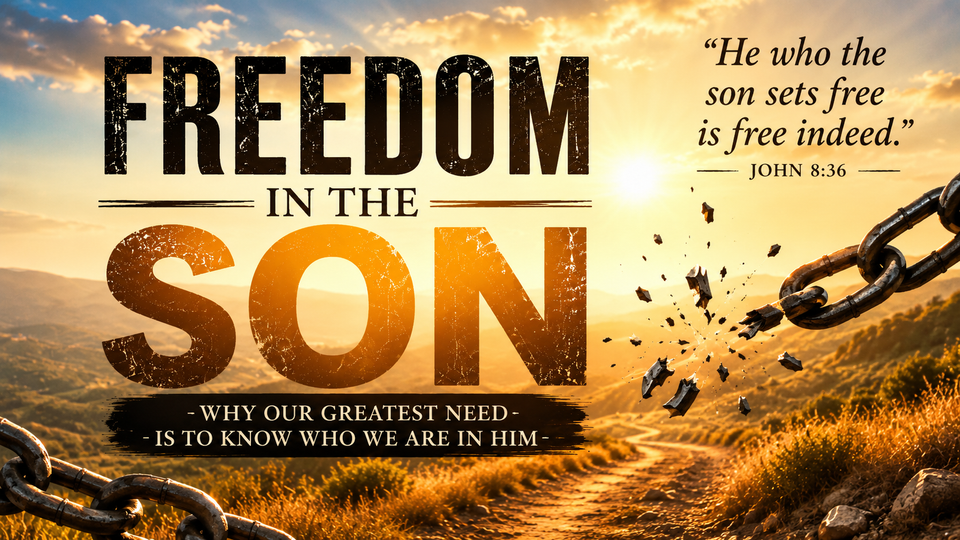
What Jesus knew about free will that our debates keep missing
For five hundred years, the church has argued about free will.
One side says God is sovereign over every choice, every heart, every turning. The other side says love must be free, that grace invites but never forces. Calvinists and Arminians have written libraries against each other. They have held synods and issued anathemas. They have split churches, ended friendships, and turned brothers into opponents.
George Whitefield and John Wesley stood on opposite sides of this divide. They preached against each other's doctrine in public and grieved over it in private. And yet, near the end of his life, Whitefield asked that Wesley preach his funeral sermon. When someone asked Whitefield whether he expected to see Wesley in heaven, he answered that he feared not, because Wesley would be so close to the throne, and Whitefield so far from it, that he would scarcely catch a glimpse of him.
Two men. Two systems. One Lord, and a love that outlasted the argument.
I want to show you where the argument dissolves. Not in a compromise. Not in a clever middle position that leaves both sides unsatisfied. It dissolves in a Person. It has always dissolved in a Person.
The Question We Keep Asking
Here is the question underneath the whole debate: Is my will truly free, or is it governed by God?
The Calvinist opens his Bible and finds a God who ordains all things. Joseph looks into the faces of the brothers who sold him and says, "You meant evil against me, but God meant it for good" (Genesis 50:20). One event. Two intentions. Both real. Peter stands up at Pentecost and preaches that Jesus was "delivered up according to the definite plan and foreknowledge of God," and in the same sentence charges his hearers: "you crucified and killed" him "by the hands of lawless men" (Acts 2:23). The early church prays it even more sharply: Herod and Pilate, Gentiles and Israel, gathered together "to do whatever your hand and your plan had predestined to take place" (Acts 4:27-28).
The pattern runs through the whole canon. God wields Assyria as "the rod of my anger" (Isaiah 10:5), then judges Assyria for the arrogance with which it swung. Pharaoh hardens his own heart, and God hardens Pharaoh's heart, and Exodus alternates between the two without blinking, without apologizing, without explaining. The potter has rights over the clay (Romans 9:21). This is true. It is on every page.
The Arminian opens the same Bible and finds a God who calls, pleads, and waits. "Choose this day whom you will serve" (Joshua 24:15). "Come to me, all who labor and are heavy laden" (Matthew 11:28). He finds a Savior weeping over a city: "How often would I have gathered your children together as a hen gathers her brood under her wings, and you were not willing!" (Matthew 23:37). He finds a God who takes no pleasure in the death of anyone (Ezekiel 18:32), who desires all people to be saved (1 Timothy 2:4), whose final word to humanity is an open door: "Let the one who is thirsty come" (Revelation 22:17). Love that is coerced is not love. This is also true. It is also on every page.
So which is it? Sovereignty or freedom? The potter or the invitation?
Wrong question.
Notice something about Scripture: it asserts both, side by side, often in the same breath, and never once shows anxiety about the tension. When Paul finally raises the objection we all want to raise, "Why does he still find fault? For who can resist his will?" (Romans 9:19), he does not retreat into careful qualifications. He answers with the potter and the clay, and then, one chapter later, he throws the doors wide open: "everyone who calls on the name of the Lord will be saved" (Romans 10:13). Romans 9 and Romans 10 sit next to each other in the same letter, written by the same hand, and Paul feels no need to referee between them.
The Bible never asks whether the will is free or governed. It asks something deeper: Whose son are you? Because in Scripture, your freedom is not defined by your options. It is defined by your union.
The Man Who Never Chose Against God
Listen to Jesus describe His own inner life:
"I always do the things that are pleasing to him." (John 8:29)
"The Son can do nothing of his own accord, but only what he sees the Father doing. For whatever the Father does, that the Son does likewise." (John 5:19)
"I have come down from heaven, not to do my own will but the will of him who sent me." (John 6:38)
"My food is to do the will of him who sent me and to accomplish his work." (John 4:34)
Now stop and ask the question our debate demands: Was Jesus free?
He never once chose against the Father. Not in the wilderness, where He answered every temptation with "It is written." Not in Galilee, where the crowds tried to make Him king on their schedule instead of the Father's. Not in Gethsemane. Not on the cross. There was never a moment when His will pulled one direction and the Father's will pulled another and He stood between them, weighing His options like Adam under the tree. His obedience was not strain. It was not mere compliance. It was food. It was nourishment. It was the thing He lived on. He said it Himself, sitting by a well, more satisfied by obedience than by the meal His disciples brought Him: "My food is to do the will of him who sent me and to accomplish his work" (John 4:34). "I delight to do your will, O my God; your law is within my heart" (Psalm 40:8).
So was He free, or was He determined?
I'll tell you, He was the freest man who ever lived. And He was fully, completely, joyfully aligned with the Father's will in every moment. Both. At once. Without contradiction, and without embarrassment.
Here is what that tells us: freedom, in the biblical vision, is not the power to defect. It is a nature so united to God that doing His will is joy. Jesus did not have less freedom because He would not sin. He had more. Sin is not what freedom looks like. Sin is what slavery looks like, and Jesus said so in the very same conversation: "everyone who practices sin is a slave to sin" (John 8:34). The prodigal in the far country had all his options open, and he was starving among the pigs. The Son is not free because He can go either way. The Son is free because He is home.
We have been measuring freedom by the width of the menu. Heaven measures it by the health of the appetite.
Gethsemane: Where the Debate Should Have Ended
If there was ever a moment when the two wills stood visible, it was in the garden.
"My Father, if it be possible, let this cup pass from me; nevertheless, not as I will, but as you will" (Matthew 26:39). Here is a real human will, recoiling from a real horror. The cup is not theater. The sweat like drops of blood is not performance. Jesus feels the full weight of what is coming, and His human nature shrinks from it, because death is an enemy and He knows it.
And then watch what happens. The human will does not get overridden. It does not get erased. It gets offered. "Not as I will, but as you will" is not the sound of a will being crushed. It is the sound of a will being given, freely, in love, in trust, in agony. This is the anti-Eden. In a garden, the first Adam took what was not given and called it freedom. In a garden, the last Adam gave what was His to keep and called it glory.
Sovereignty did not cancel that choice. The choice did not threaten that sovereignty. The cross was "the definite plan of God" and it was the freest act of love in human history, and Gethsemane is where those two truths kneel down in the same body and pray with one voice.
Every Calvinist should stand in that garden and see a will that really wrestled. Every Arminian should stand in that garden and see a plan that could not fail. And both should leave quieter than they came.
What Each Side Has Been Protecting
Now watch what happens to the old war.
The Calvinist has been protecting the truth that God's purpose cannot fail. That salvation is His work from first to last. That no rebel will is strong enough to overthrow the plan, that grace is not a suggestion but a resurrection, that dead men do not raise themselves (Ephesians 2:4-5). Keep protecting it. It is true. The cross was not an accident that God salvaged. It was the Lamb slain according to plan, and the empty tomb was never in doubt.
The Arminian has been protecting the truth that God is not a puppet master. That His commands are real commands, His warnings are real warnings, His grief over sin is real grief. That when He says "come," He means it, and when He says "whoever," He means whoever. Keep protecting it. It is true. The invitations of God are not theater, and no one will stand at the judgment and truthfully say the door was locked.
But notice what both sides have been arguing about: the will of the old man. The autonomous self. The Adam-will, standing at a distance from God, weighing its options, deciding whether to trust. One side says that will is bound and must be overcome. The other side says that will is free and must be persuaded. And the gospel says something more radical than either:
That will is crucified.
"I have been crucified with Christ. It is no longer I who live, but Christ who lives in me. And the life I now live in the flesh I live by faith in the Son of God, who loved me and gave himself for me" (Galatians 2:20). The goal of redemption was never to liberate the independent will. It was never to override it, either. The goal was to end its independence altogether, to take the heart of stone out of the flesh and give a heart of flesh, to put a new spirit within (Ezekiel 36:26-27). "I will put my law within them, and I will write it on their hearts" (Jeremiah 31:33). Not law imposed from outside, demanding compliance. Law written inside, producing desire. This is why “delight yourself in the Lord” was never about God granting independent wishes; in the Hebrew sense, it carries the idea that He places desires into the heart, forming and shaping them, so that our desires become His.
The new covenant does not resolve the free will debate. It retires it. A heart with the law written on it does not experience God's will as a rival to its own. It experiences God's will as its own deepest want, finally uncovered.
The Long Story of Sonship
Step back and see the shape of the whole story.
Adam was a son of God, placed in a garden, given everything, and asked to trust. He grasped at autonomy instead and called it becoming like God, not knowing he already was. Israel was God's son, called out of Egypt (Hosea 11:1), carried through the sea, fed in the wilderness. "Out of Egypt I called my son." And the son tested his Father at every station, demanded bread on his own terms, built a calf while the covenant was still being written.
Then Jesus steps into the story, and Matthew makes sure we cannot miss it. He comes up out of Egypt. He passes through the waters of baptism. He is led into the wilderness for forty days, retracing forty years. And at every point where Adam grasped and Israel grumbled, the Son stands and says, "It is written." Where the first son took, this Son receives. Where the old son demanded, this Son delights.
When Jesus says "I always do the things that are pleasing to him," He is not making small talk about His devotional life. He is announcing that the long story of failed sonship has finally produced a faithful Son. The true Israel. The last Adam. And His obedience is not just personal piety. It is covenantal repair. The whole ruined lineage of sonship is being rebuilt in one Man, from the inside.
And here is the part that should take your breath: He did not come to be the exception. He came to be the firstborn.
"For those whom he foreknew he also predestined to be conformed to the image of his Son, in order that he might be the firstborn among many brothers" (Romans 8:29)
The Father was never after one obedient Son. He was after a family that bears the resemblance.
What He Claims, He Shares
What Jesus claims uniquely, He shares freely.
"Abide in me, and I in you. As the branch cannot bear fruit by itself, unless it abides in the vine, neither can you, unless you abide in me" (John 15:4)
The branch does not strain to produce grapes. It does not weigh its options every morning and decide whether to participate in the vine. It abides, and the life flows, and the fruit comes because the union is real.
"If anyone loves me, he will keep my word, and my Father will love him, and we will come to him and make our home with him" (John 14:23). Home. That is the destination of this whole story. Not a will forever poised between obedience and rebellion, white-knuckling its way through eternity. A will swallowed up in love. Peter dares to say it plainly: through His promises we "become partakers of the divine nature" (2 Peter 1:4). Jesus prays it the night before He dies: "that they may all be one, just as you, Father, are in me, and I in you, that they also may be in us" (John 17:21).
The same union Jesus lived is the union He gives. That is the inheritance. That is the gospel's finish line, and it is not far off. It is now. "Because as he is so also are we in this world" (1 John 4:17).
Ask the man who is fully united to God whether he is sovereignly kept or freely choosing. He will not understand the question. He is loved, and he loves. He is held, and he clings. He is kept, and he stays, and he could not tell you where the keeping ends and the staying begins, any more than a branch could tell you where the vine's life ends and its own begins. That is not a problem to be solved. That is the design.
The Table Is Bigger Than the Argument
So let the Calvinist and the Arminian lay down their weapons at the same feet.
One of you has been defending the Father's sovereignty, and heaven thanks you for it. One of you has been defending the reality of love, and heaven thanks you for that too. You were never guarding rival gods. You were guarding two sides of one throne, and in Jesus, sovereignty and love are not rivals. They are one will, one delight, one Son, kneeling in a garden, giving everything, losing nothing.
The old man argues about whether his will is free. The new man has stopped asking, because his will has found its home, and home does not feel like a cage. It feels like the first free breath he ever took.
This argument was never going to be won.
It was always going to be outgrown.
If these messages have encouraged you, like, comment and subscribe. Please consider planting a seed. Your generosity helps continue this work and creates opportunities for others to grow and strengthen their faith.

Member discussion