From Chronos To Kairos
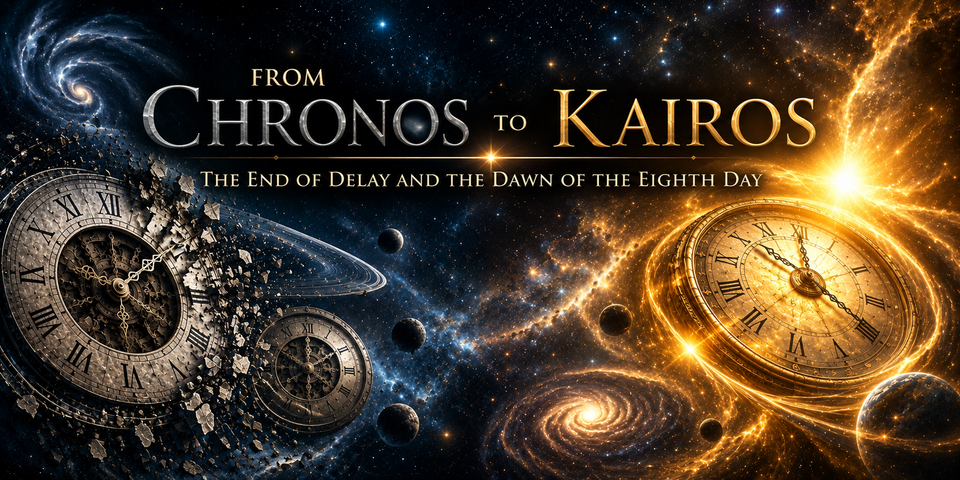
The End of Delay and the Dawning of the Eighth Day
There is a phrase in the book of Revelation that has echoed through generations, often misunderstood, often placed into a distant future filled with fear and speculation: “that there should be time no longer.” For many, this has been interpreted as the end of time itself, as though creation will suddenly collapse and history will cease. But what if this phrase is not announcing the end of existence, but the fulfillment of something long awaited? What if it is not about the destruction of time, but the end of delay? I want to invite you to slow down with me and look again, not through the lens of fear or futurism, but through the finished work of Christ and the covenant story that Scripture has been telling from the beginning.
“And swore by him that liveth for ever and ever, who created heaven, and the things that therein are, and the earth, and the things that therein are, and the sea, and the things which are therein, that there should be time no longer.” (Revelation 10:6)
The word translated “time” here is the Greek word chronos, and this is where clarity begins. Kronos does not primarily refer to time as in clocks or the passing of seconds; it refers to a measured span, a duration, a divinely allotted delay that is allowed to run its course. This is why many translations render it more accurately as, “there will be no more delay.” (NIV, AMP, TPT, NKJV & more) The angel is not announcing the end of creation, but the end of a waiting period. Something that had been measured out by God had reached its appointed completion. The question then becomes, what was that measured span? Scripture answers this consistently when we allow it to speak in its own voice.
Jesus Himself anchored the fulfillment of His prophetic words within a specific generation, not an indefinite future. “Verily I say unto you, This generation shall not pass, till all these things be fulfilled.” (Matthew 24:34) The apostles carried this same sense of nearness, not as exaggeration, but as lived reality. “But the end of all things is at hand: be ye therefore sober, and watch unto prayer.” (1 Peter 4:7) “Little children, it is the last time… whereby we know that it is the last time.” (1 John 2:18) “Be ye also patient; stablish your hearts: for the coming of the Lord draweth nigh… behold, the judge standeth before the door.” (James 5:8–9) These are not the words of men speaking about events thousands of years away. These are the words of men standing at the edge of a covenantal transition, living in what Scripture calls the “last days,” not of the planet, but of an age—the age defined by temple, sacrifice, priesthood, and law.
When Revelation declares that there would be no more Kronos , it is announcing that this measured age had reached its fulfillment. No more delay. No more waiting for what the prophets had pointed toward. The shadow had served its purpose, and the substance had come. To see this more clearly, we must understand another Greek word that stands in contrast to Kronos, and that is kairos. If kronos is measurable time, kairos is appointed time, the decisive moment when what has been promised becomes reality. When Jesus began His ministry, He declared, “The time is fulfilled, and the kingdom of God is at hand.” (Mark 1:15) The word used here is kairos. Not that time was passing, but that the appointed moment had arrived. This is the movement we are seeing in Revelation, from kronos to kairos, from delay to fulfillment, from waiting to manifestation. Not a postponement of Daniel’s 70th week, not a 2000 year postponement of the kingdom as dispensationalism preachers, but then. Remember the opening chapter in Revelation say’s,
“blessed is the one who reads aloud the words of this prophecy, and those who hear, and who keep written in it, for the time is near.” (Revelation 1:3)
Time here in this verse is also Kairos, meaning, the appointed time. The amplified version says for the time of fulfillment is near.
This transition is deeply rooted in the biblical pattern of the eighth day. Throughout Scripture, the number seven represents completion, the finishing of a cycle. But the eighth day represents something beyond that cycle, the beginning of something entirely new. Circumcision, the sign of covenant identity, was given on the eighth day. “And in the eighth day the flesh of his foreskin shall be circumcised.” (Leviticus 12:3) The Feast of Tabernacles culminated in an eighth day gathering. “On the eighth day shall be an holy convocation unto you.” (Leviticus 23:36) And most profoundly, Jesus rose from the dead on the first day of the week, which is also the eighth day, the day that begins a new creation. The resurrection is not just an event; it is the inauguration of a new order of existence. So when Revelation announces that there is no more chronos, it is declaring that the old covenant cycle has reached its completion and that the eighth day, the new creation age, has fully dawned. This is why I firmly stand and believe that the book of Revelation is the culminating events leading up to the destruction of the whole system, including the temple, priesthood and even the city of Jerusalem itself.
This is why Jesus could speak in such a striking way to the woman at the well, collapsing what seemed like future expectation into present reality. “Woman, believe me, the hour cometh, when ye shall neither in this mountain, nor yet at Jerusalem, worship the Father… But the hour cometh, and now is, when the true worshippers shall worship the Father in spirit and in truth.” (John 4:21, 23) Notice the language, “the hour is coming, and now is.” This is the overlap of kronos and kairos, where the old is fading and the new is breaking in. Under the old covenant, everything was structured around time and place—appointed days, sacred seasons, geographic locations, mediated access through priests. Time itself was covenantally structured. But in Christ, that structure gives way to something greater. Access is no longer bound to location, presence is no longer confined to a building, a city, or a mountain and worship is no longer restricted to a system. The veil is torn, the Spirit is given, and the dwelling place of God becomes His new covenant people; the Church and true Israel of God.
Revelation continues by saying, “But in the days of the voice of the seventh angel… the mystery of God should be finished.” (Revelation 10:7) This is not a mystery of destruction, but a mystery of revelation. Paul defines it clearly: “Even the mystery which hath been hid from ages and from generations, but now is made manifest to his saints… which is Christ in you, the hope of glory.” (Colossians 1:26–27) The mystery was never about the end of the world; it was about the union of God and man, the inclusion of the Gentiles, the formation of one new humanity in Christ. This is why Paul could say, “Now all these things happened unto them for examples… upon whom the ends of the ages are come.” (1 Corinthians 10:11) Not the end of the earth, but the end of the ages, the closing of covenantal epochs. They were living in that transition, standing at the threshold where kronos was ending and kairos was arriving.
History itself bears witness to this transition. In AD 70, the temple was destroyed, the sacrificial system ceased, and the entire old covenant structure reached its visible end. This was not random history, but covenantal fulfillment. The measured delay had run its course. No more kronos. And what remained was not emptiness, but fullness, not absence, but presence. The New Testament consistently speaks in this language of present reality: “For ye are dead, and your life is hid with Christ in God.” (Colossians 3:3) “If any man be in Christ, he is a new creature: old things are passed away; behold, all things are become new.” (2 Corinthians 5:17) “But ye are come unto mount Sion… and to the city of the living God, the heavenly Jerusalem.” (Hebrews 12:22) These are not future promises; they are present realities. This is kairos. This is the eighth day. This is life in the new creation.
When we see this, it reshapes how we live. If we believe we are still in delay, we will always be waiting; waiting for God to move, waiting for access, waiting for something to change. But if chronos has ended and kairos has arrived, then we are no longer a waiting people; we are a participating people. We are not striving to reach God; we are living from union with Him. We are not looking for a distant moment when everything will be made right; we are awakening to the reality that in Christ, everything has already been brought into its fulfillment. This is why Hebrews says, “There remaineth therefore a rest to the people of God. For he that is entered into his rest, he also hath ceased from his own works, as God did from his.” (Hebrews 4:9–10) The rest is not ahead of us; it is entered. The work is not ongoing; it is finished. The delay is not continuing; it has ended.
So when we read, “that there should be time no longer,” we are not reading about the end of clocks or the collapse of creation. We are reading about the end of a covenantal delay, the completion of an age, and the full unveiling of what had been promised all along.
The eighth day has dawned. The mystery has been revealed. Christ is not distant; He is within. The kingdom is not postponed; it is present. And of the increase of His government and peace, there shall be no end. (Isaiah 9:7) The invitation before us is not to wait for another age, but to awaken to the one we are already in, to live from union, to walk in rest, and to embody the reality that the delay is over, Christ is forever victorious and the fulfillment has come.
If these messages have encouraged or uplifted you, consider giving back by planting a seed. Your generosity helps continue this work and creates opportunities for others to grow and strengthen their faith.

Member discussion