Not One Jot Left Behind
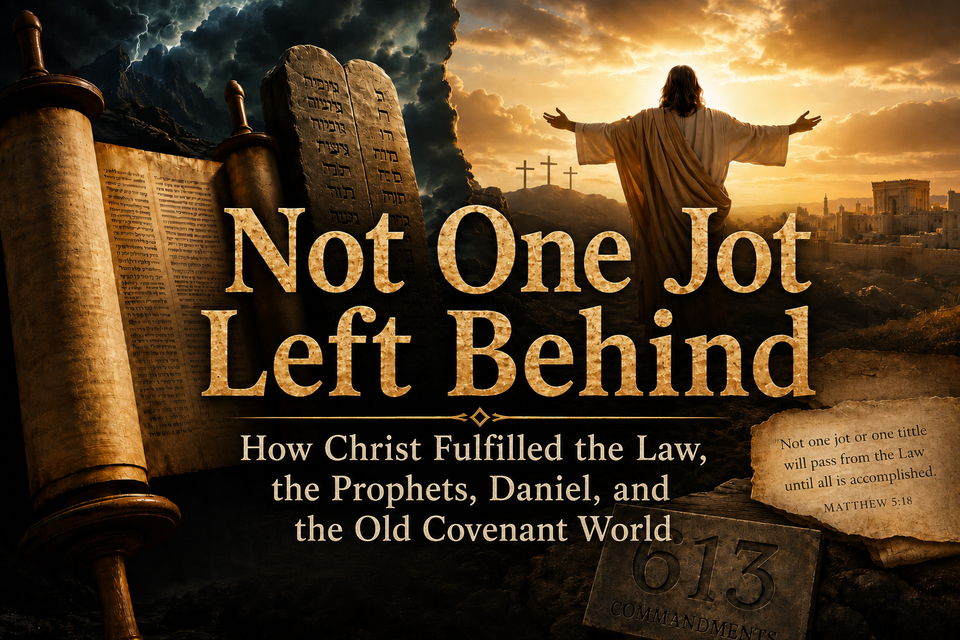
How Christ Fulfilled the Law, the Prophets, Daniel, and the Old Covenant World
The Weight of Jesus’ Words
There are some words of Jesus we read too quickly because we already think we know what they mean. Matthew 5:17–18 is one of those passages. It has been quoted, preached, debated, softened, divided, and sometimes quietly ignored, but it refuses to go away. Jesus said,
“Do not think that I have come to abolish the Law or the Prophets; I have not come to abolish them but to fulfill them. For truly, I say to you, until heaven and earth pass away, not an iota, not a dot, will pass from the Law until all is accomplished.” — Matthew 5:17–18
That is not a casual statement. That is not Jesus giving us a sweet little devotional thought about Bible accuracy. That is a covenantal bomb sitting right in the middle of the Sermon on the Mount.
The issue is simple, but it is not small. Jesus said not one jot, not one tittle, not one smallest stroke of the Law would pass away until all was fulfilled. The question, then, is not whether we love the Old Testament. Of course we do. The question is whether Jesus fulfilled what the Law and the Prophets were pointing toward, or whether the Old Covenant still stands over us with every letter intact. Because according to Jesus, there is no middle ground where sacrifices are gone, circumcision is optional, food laws are dismissed, the priesthood is obsolete, the temple is unnecessary, but a large portion of Old Testament prophecy remains unfulfilled. Jesus did not say, “Some of the Law will pass when some things are fulfilled.” He said not one stroke would pass until all was accomplished.
What “The Law and the Prophets” Really Means
This matters because “the Law and the Prophets” was not a phrase for a handful of moral principles. It was a way of speaking about the whole covenantal witness of Israel’s Scriptures. The BibleProject rightly notes that in Matthew 5:17 Jesus says He came to fulfill “the Law and the Prophets,” a traditional phrase referring to the whole Hebrew Bible, and that fulfillment is more than simple obedience to statutes; it is Jesus filling full the story those Scriptures were telling. So when Jesus says He came to fulfill the Law and the Prophets, He is not merely saying, “I came to be a good Torah-observant Jew,” although He certainly was. He is saying, “I came as the One to whom Moses, the Prophets, the Psalms, the sacrifices, the priesthood, the temple, the promises, the curses, the feasts, the shadows, and the kingdom hope were all pointing.”
That is why the word “fulfill” is so important. In Matthew’s Gospel, fulfillment is not vague religious language. It means something anticipated has arrived, something promised has come to pass, something written has reached its intended goal. B. M. Trout, in an exegetical study of Matthew 5:17, argues that Jesus fulfills the Law and the Prophets by bringing into being what they anticipated, specifically the arrival of the Kingdom of God. He writes that “fulfilment means that the kingdom has come,” and that Jesus fulfills the Law and Prophets “by bringing about the Kingdom they anticipated.” That is the heart of the matter. Fulfillment is not the cancellation of Moses. Fulfillment is Moses reaching Christ. Fulfillment is not God changing His mind. Fulfillment is God keeping His word.
Not One Stroke Left Unfulfilled
Now look carefully at the force of Jesus’ warning. He says not one iota or dot would pass from the Law until all was accomplished. Brandon Crowe explains that the iota and dot likely refer to the smallest strokes of the Hebrew alphabet, showing that Jesus viewed the Old Testament as trustworthy down to the smallest detail. Augustine said the same thing centuries earlier when he wrote that Jesus’ words show “all the smallest particulars” of the Law were to be carried into effect. Chrysostom put it even more directly: “it cannot be that it should remain unaccomplished, but the very least thing therein must needs be fulfilled.” In other words, Jesus left no loose threads hanging from Moses. No leftover tassels. No forgotten shadows. No half-fulfilled covenant.
And this is where the modern Christian world has to slow down and feel the weight of its own theology. If anything required by the Law and the Prophets remains unfulfilled, then by Jesus’ own words not one jot or tittle has passed. And if not one jot or tittle has passed, then we are not merely having a debate about end-times charts. We are having a debate about whether we are still bound to Moses. According to Jewish tradition, the Torah contains 613 commandments, drawn from the Talmud’s reckoning in Makkot 23b: 248 positive commandments and 365 negative commandments. So let us be honest. If the Law has not passed because all has not been fulfilled, then the issue is not just whether we expect a future temple or a future tribulation. The issue is whether we should be preparing to live under the entire covenantal administration of Sinai.
The Law as a Unified Covenant
And please hear me, I am not saying this to be cute. I am saying this because Jesus made the argument this tight. Paul understood it this way too. In Galatians 5:3 he said, “I testify again to every man who accepts circumcision that he is obligated to keep the whole law.” James said, “Whoever keeps the whole law but fails in one point has become guilty of all of it” (James 2:10). The Law was never a buffet where we keep the moral broccoli, skip the ceremonial mashed potatoes, and grab a little prophetic dessert on the way out. The Law came as a covenant. It stood together. It judged together. It cursed together. It was glorious, but it was a ministry of death written on stone, fading before the greater glory of the Spirit (2 Corinthians 3:7–11).
This is why dividing the Law into “moral, civil, and ceremonial” may help us discuss categories, but it cannot override the covenantal force of Matthew 5:18. Jesus did not say, “Not one jot or tittle of the moral law will pass until some spiritual things are fulfilled.” He said not one jot or tittle would pass from the Law until all was fulfilled. David Wenham, discussing Matthew 5:17–20, admits that the statement is “a broad one about the law and the prophets in general,” even while arguing for distinctions in Christian application. That is exactly the point. The passage itself is not narrow. Jesus tied the continuing authority of the Law to the fulfillment of everything the Law and Prophets anticipated.
The Transition of the Ages
This is also why Luke 16:16–17 is so important. Jesus said, “The Law and the Prophets were until John; since then the good news of the kingdom of God is preached.” Then, immediately, He said, “It is easier for heaven and earth to pass away than for one dot of the Law to become void.” Do you see the transition? The Law and the Prophets were until John, because John stood at the doorway of the Kingdom announcement. But the Law could not simply evaporate because the Kingdom was preached. Every stroke had to be fulfilled. The Kingdom had arrived in Christ, but the Old Covenant world had not yet vanished. That generation stood in the overlap of the ages: the old was becoming obsolete and ready to vanish away, while the new was being revealed in Christ.
That is precisely the language of Hebrews.
“In speaking of a new covenant, he makes the first one obsolete. And what is becoming obsolete and growing old is ready to vanish away” — Hebrews 8:13
Notice the timing. Hebrews does not say the old covenant vanished the moment Jesus was born. It does not even say it vanished immediately at the cross in its historical administration. It says it was obsolete and ready to vanish. The sacrifice of Christ had finished the work. The priesthood had changed. The new covenant had been inaugurated in His blood. But the old temple still stood. The priests were still offering animals. The city still represented the old order. The visible covenantal structure remained until the days of vengeance came and everything written reached its covenantal conclusion.
The Days of Vengeance
That is why Jesus’ words in Luke 21:20–22 are so massive. Speaking of Jerusalem surrounded by armies, He said, “Then know that its desolation has come near.” Then He told those in Judea to flee, and explained, “These are days of vengeance, to fulfill all that is written.” The context is not vague. It is Jerusalem. It is Judea. It is the city being surrounded. It is wrath upon that people. BibleHub’s summary rightly connects Luke 21:22 with Jerusalem’s destruction and says these events were “in accordance with prophecies found in the Hebrew Scriptures,” including Daniel. Jesus was not guessing. He was interpreting Israel’s prophetic story. He was saying that the fall of Jerusalem would be the covenantal moment when the written judgments of the Law and Prophets came crashing down on the old world.
And Matthew gives us the timeline nobody wants to leave alone.
“Truly, I say to you, this generation will not pass away until all these things take place” — Matthew 24:34
Not “that generation thousands of years later.” Not “the generation that sees these things start.” Jesus spoke to His disciples about the temple standing in front of them and told them the judgment would fall within that generation. Luke says these would be the days of vengeance to fulfill all that was written. Matthew says all these things would happen before that generation passed. Hebrews says the old covenant was ready to vanish. Paul says the end of the ages had come upon them (1 Corinthians 10:11). Peter says the end of all things was at hand (1 Peter 4:7). John says it was the last hour (1 John 2:18). At some point, we may want to stop telling the apostles they had bad watches.
Daniel 12 and the Question of Completion
Now we have to bring Daniel 12 into the room, because Daniel 12 is one of the clearest tests of this whole system. Daniel speaks of a time of trouble for his people, deliverance, judgment, resurrection language, the wise shining like the brightness of the heavens, and then the question is asked, “How long shall it be till the end of these wonders?” The answer is stunning:
“It would be for a time, times, and half a time, and when the shattering of the power of the holy people comes to an end all these things would be finished” — Daniel 12:7
Even in BibleHub’s Daniel 12:7 note it connects this phrase with a period of tribulation and says the completion of “all these things” points to the fulfillment of God’s prophetic plan.
So here is the question that must be faced. Daniel 12 includes resurrection and judgment language. N. T. Wright says clear statements of resurrection in the Hebrew Bible are rare and that Daniel 12 is “the most blatant.” Chris Gousmett likewise calls Daniel 12:2 the most explicit Old Testament reference to resurrection and judgment, arguing that the text places the resurrected before the bar of judgment. If Daniel 12 is still future, then resurrection and judgment from the Law and Prophets remain unfulfilled. And if those remain unfulfilled, then by Jesus’ own standard not one jot or tittle has passed from the Law. And if not one jot or tittle has passed, then we need to have an honest conversation about circumcision, feast days, ritual purity, Levitical priesthood, animal sacrifices, temple worship, and the whole 613-commandment world of Moses.
The Problem of Inconsistency
That sounds extreme only because we have been trained to live with contradictions. We say the Old Covenant is gone, but the Old Testament prophetic hope is not fulfilled. We say the Law passed away, but the Law and the Prophets still have major covenantal promises hanging in the future. We say Jesus fulfilled the sacrifices, but not the judgment. He fulfilled the priesthood, but not Daniel. He fulfilled Passover, but not resurrection. He fulfilled Isaiah 53, but not Isaiah 65. He fulfilled the Lamb, but not the New Heavens and New Earth. But Jesus did not divide the Scriptures that way. He said the Law and the Prophets stood intact until all was accomplished.
And Daniel tells us when all those wonders would be finished: when the power of the holy people was shattered. What was the power of the holy people under the Old Covenant? It was the temple, the city, the priesthood, the sacrifices, the genealogies, the altar, the land-centered covenant administration. And in AD 70, that world was shattered. Not bruised. Not inconvenienced. Shattered. The temple burned. The sacrifices ceased. The priestly records were lost. The city fell. The old covenant heavens and earth were shaken. The mountain that could be touched gave way to Mount Zion, the heavenly Jerusalem, the city of the living God (Hebrews 12:18–24).
Heaven and Earth
This is why “heaven and earth” in Matthew 5:18 should not be flattened into a statement about the physical universe continuing to exist. Moses had already called covenant witnesses “heaven and earth” over Israel (Deuteronomy 30:19; 31:28; 32:1), language rooted in the covenant structure centered on the land, the temple, and the nation itself. Isaiah spoke of God planting the heavens and laying the foundations of the earth in connection with saying to Zion, “You are my people” (Isaiah 51:16), tying “heaven and earth” directly to the establishment of Israel’s covenant identity. In this sense, the “old heaven and earth” was not merely the physical cosmos, but the entire covenantal world of Israel—its temple system, priesthood, sacrifices, and national life centered in Jerusalem. The prophets often used cosmic language for covenantal upheaval. When Babylon fell, the stars were darkened and the heavens shook (Isaiah 13:10, 13). When Edom was judged, the host of heaven dissolved and the sky rolled up like a scroll (Isaiah 34:4). This is prophetic language for the collapse of a world-order under divine judgment.
In the same way, the passing away of “heaven and earth” in Jesus’ teaching points to the dissolution of that old covenant order, which reached its climactic end in the destruction of Jerusalem and its temple in AD 70. What was passing was the physical, national, temple-centered administration of God’s people. In its place, Christ established the “new heaven and new earth," not a different planet, but a new covenant administration in which God’s people are no longer defined by geography, ethnicity, or temple rituals, but by union with Christ. The Church becomes the true temple (Ephesians 2:19–22), the dwelling place of God by the Spirit, and the true and everlasting center of His kingdom on earth. So when Jesus says heaven and earth would pass away, but His words would not pass away, He is speaking as the true covenant Lord whose word would outlast and fulfill the entire Mosaic age, ushering in the enduring reality of the new covenant world. What we call the 8th day.
Fulfillment, Not Abolition
This does not make the Law meaningless. It makes it fulfilled. It does not make Moses wrong. It makes Moses prophetic. It does not make the temple evil. It makes the temple temporary. It does not make the sacrifices foolish. It makes them shadows of the Lamb. It does not make the priesthood pointless. It makes it a signpost to the priest forever after the order of Melchizedek. It does not make circumcision worthless. It reveals its true goal: circumcision of the heart by the Spirit. It does not make Sabbath vanish into nothing. It brings Sabbath into its living reality: rest in Christ.
Paul says Christ is the end of the Law for righteousness to everyone who believes (Romans 10:4). The word “end” does not mean Jesus threw the Law in the trash. It means He is the goal. The destination. The telos. The Law was a tutor until Christ came (Galatians 3:24–25). But after faith has come, we are no longer under the tutor. That is not antinomianism. That is graduation. That is not lawlessness. That is new creation. The righteousness of the Law is fulfilled in those who walk according to the Spirit (Romans 8:4), not because we are dragging Sinai behind us, but because the life of Christ has been formed within us.
The Final Question
So let the question sit on the table with all its weight. If Jesus did not fulfill all the Law and the Prophets, why are we not under every jot and tittle? If Daniel’s resurrection and judgment remain unfulfilled, why are we not still waiting under Moses? If the days of vengeance did not fulfill all that was written, why did Jesus say they would? If the old covenant has vanished, how did it vanish before all was accomplished? And if all has not been accomplished, who gave us permission to stop obeying the covenant Jesus said would remain intact down to the smallest stroke?
The Eighth Day Reality
The good news is that we are not under the 613 commandments. We are not waiting for a rebuilt temple. We are not looking for another priesthood. We are not returning to animal blood. We are not standing at Sinai trembling beneath a covenant of condemnation. We are living in the eighth day, the new creation age of the risen Christ. The Law and the Prophets have not been abolished. They have been fulfilled. Moses has not been dishonored. He has been vindicated in the Son. Daniel has not been postponed. He has been brought to his covenantal goal in the shattering of the old world and the unveiling of resurrection life in Christ.
That is why the believer can breathe. That is why the conscience can rest. That is why we do not need to rebuild what God removed. The old heavens and earth have passed. The new creation has come. The temple is Christ and His body. The priesthood is royal. The sacrifice is finished. The city is heavenly. The kingdom cannot be shaken. And not one jot or tittle failed. Every stroke found its Amen in Jesus.
So no, we are not going back to Moses. We are not picking up the yoke Peter said neither they nor their fathers were able to bear (Acts 15:10). We are not patching the veil back together. We are not pretending the shadow still owns the room after the Substance has arrived. We are standing in the finished work of Christ, where the Law is fulfilled, the Prophets are satisfied, Daniel’s vision is complete, and the sons of God live in the light of the everlasting Kingdom.
If anything is still undone, then back to the 613 we go.
But if Jesus told the truth, and He did, then welcome to the eighth day.
If these messages have encouraged you, like, comment and subscribe. Please consider planting a seed. Your generosity helps continue this work and creates opportunities for others to grow and strengthen their faith.

Member discussion