The Renewed Mind
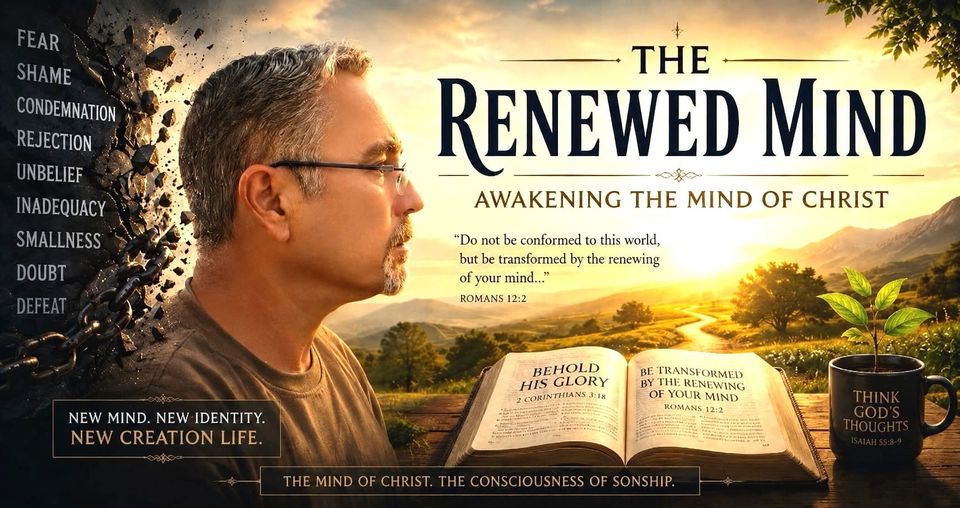
Demolishing Mental Strongholds and Cultivating the Mind of Christ
Introduction
There is a war being waged not on the battlefield of nations, but in the interior country of the human mind. Every thought, every habitual pattern, every assumption you hold about yourself, about God, and about the world is either a stronghold of the old man or a seedbed of the new creation. Paul knew this. The apostle, writing from the crucible of imprisonment and revelation, declared it plainly: transformation comes not through effort of will, but through the renewal of the mind. This is not self-help language dressed in theological clothing. This is the thunderclap at the center of the Gospel, that the same God who raised Jesus from the dead is actively, presently, and powerfully at work remaking the architecture of your thinking.
"Do not be conformed to this world, but be transformed by the renewing of your mind, that you may prove what is that good and acceptable and perfect will of God." — Romans 12:2
The word Paul uses here for transformed is the Greek metamorphoō, the same root from which we derive metamorphosis. He is not speaking of behavioral modification or moral improvement. He is speaking of a change in the nature of being. The caterpillar does not try harder to become a butterfly. It surrenders to a process that dismantles the old form entirely and reconstitutes it into something of an altogether different order. This is the kind of transformation the Holy Spirit is after in you.
Part One:
The Science of the Renewed Mind
For centuries, scientists believed the brain was fixed after childhood, a static organ whose structures were permanently shaped by early development. That assumption has now been shattered. Modern neuroscience is now confirming that, what the Spirit-breathed Word declared thousands of years ago: that the brain is plastic. It changes. It rewires. It forms new pathways while allowing old ones to weaken and die through disuse. The science of neuroplasticity is not creating a new truth; it is uncovering an ancient one, an eternal reality woven into the wisdom of God and written through His prophets and apostles thousands of years ago: that the human mind can be renewed, transformed, and made new.
This is why I have witnessed not only in my own transformation, but also in the transformation of multitudes of men whose lives were marked by neglect, abuse, abandonment, violence, addiction, rejection, shame, and deep emotional trauma from childhood onward. Through the power of the Gospel, they did not merely adopt better coping mechanisms, they encountered true salvation. The Greek word for salvation (sozo) means far more than forgiveness of sins alone; it speaks of healing, deliverance, restoration, wholeness, and rescue. I have watched broken men become whole, tormented minds become peaceful, and hearts chained to horrifying pasts become free. I have seen men learn to forgive those who wounded them, love those who betrayed them, and walk out of cycles of fear, rage, self-hatred, unforgivness and destruction into the reality of becoming entirely new creations in Christ.
“The brain is not like a computer with fixed hardware. Every experience, every thought, and every repeated behavior physically reshapes the neural circuitry of the brain.”
— Caroline Leaf, Switch On Your Brain
Every time you meditate on the Word of God, truly meditate and not merely read, neurons in your brain fire together. And in the language of neuroscience, neurons that fire together wire together. The Hebrew word for meditate, hāgāh, carries the sense of a low, repetitive murmur: like a student muttering the text until it becomes part of them. This is not passive devotion. This is neurological renovation by divine design. When you take a truth from Scripture and turn it over in your heart, speak it with your lips, return to it again and again, you are literally carving new pathways through the matter of your brain. And to reiterate, the Word of God knew about this all along
"This Book of the Law shall not depart from your mouth, but you shall meditate in it day and night, that you may observe to do according to all that is written in it. For then you will make your way prosperous, and then you will have good success." — Joshua 1:8
God was not giving Joshua a mere devotional suggestion; He was giving him a divine prescription for the renewal and stabilization of the human mind. Prosperity and good success were never presented as the reward for anxious striving or self-generated effort, but as the natural fruit of a life continually saturated with, shaped by, and governed through divine truth. The command to meditate upon the Word day and night was not rooted in legalistic performance, but in transformation through continual immersion in the Word (Logos), which is the mind of God. As I told my children from the time they were little, "the mind is like a garden: whatever you plant, you will reap that crop." If you sow doubt, doubt will grow; but if you intentionally plant truth, faith, hope, and the Word of God, the soul becomes fertile ground for peace, wisdom, and spiritual stability.
Yet even within this intentionality lies one of the great paradoxes of the Kingdom. Scripture calls us to meditate, to renew the mind, and to take every thought captive unto the obedience of Christ (Joshua 1:8; Romans 12:2; 2 Corinthians 10:5). Such things require intentionality and discipline, yet not the kind rooted in self-effort, anxiety, or striving. Rather, this labor is the continual training of the mind to cease from its own works, just as God ceased from His (Hebrews 4:10-11). We labor to enter that rest. We intentionally confront fear, unbelief, condemnation, and the illusion of separation from God, not through the exertion of the flesh, but by yielding more deeply to what Christ has already accomplished.
Thus, beneath all true spiritual growth lies a deeper foundation, not striving, but resting: resting in the reality that, as new creations, everything pertaining to life and godliness has already been deposited within us through union with Him (2 Peter 1:3; 2 Corinthians 5:17). Spiritual maturity, therefore, is not the creation of something absent, but the awakening and cultivation of what grace has already made present within us. This is why the writer of Hebrews could say:
“Let us labor therefore to enter into that rest.”
Hebrews 4:11
The labor is not the exhausting effort of trying to become accepted by God, but the intentional yielding of the mind and heart into the finished work already accomplished through Jesus Christ. This is the sacred dichotomy of the Kingdom, a holy intentionality that flows not from insecurity, fear, or self-effort, but from abiding in what has already been fulfilled through union with Christ.
The Logos of God, when allowed to dwell richly within the corridors of human thought, does not merely inform the believer, it reforms him. It reconstructs the inner world of perception and identity. It uproots ancient structures of fear, shame, rejection, insufficiency, and smallness, and replaces them with the confident, peaceful, and expectant consciousness of sonship. This is why Paul declared that as we behold, as in a mirror, the glory of the Lord, we are being transformed into the same image from glory to glory by the Spirit of the Lord (2 Corinthians 3:18). The Word of God does not simply modify behavior externally, it transforms consciousness internally. In beholding Christ, the believer begins to see his own true identity unveiled within Him, and through that beholding, transformation naturally unfolds.
Transformation, then, is not the anxious striving to become someone we are not, but the unfolding revelation of who we already are in Him. It is the gradual awakening of the new creation life already placed within us through Christ, as the Spirit continually reveals what has been true of us all along.
Part Two
Strongholds and the Dismantling of Old Patterns
Before the mind can be renewed, we must understand what it is being renewed from. Paul, in his second letter to the church at Corinth, names the enemy clearly. He does not point to culture, or government, or circumstance. He points inward, to the structures of thought that have made their home in the human heart and established themselves as governing stronghold realities.
"For the weapons of our warfare are not carnal but mighty in God for pulling down strongholds, casting down arguments and every high thing that exalts itself against the knowledge of God, bringing every thought into captivity to the obedience of Christ." — 2 Corinthians 10:4-5
A stronghold is not merely a sinful habit. It is a thought-structure, a patterned way of interpreting reality that has been reinforced over years until it feels like truth. The orphan spirit is a stronghold. The belief that you must earn acceptance, that love is conditional, that God is primarily disappointed in you: these are strongholds. And they are, in the language of neuroscience, deeply entrenched neural pathways, grooved into the brain through repetition, trauma, and agreement with the enemy's accusations. They feel immovable because they have become neurologically embedded. But the weapons of our warfare are mighty in God, and no neural pathway is beyond the renovating reach of the Holy Spirit.
"Negative thought patterns are like superhighways in the brain — deeply rutted, fast, and automatic. But the brain's plasticity means those highways can be bypassed. New roads can be built. The question is what you choose to think on."
— Dr. Andrew Newberg, neuroscientist, How God Changes Your Brain
This is not just therapeutic recovery. This is spiritual warfare at the neurological level. Every time you refuse a toxic thought and instead confess the truth of God's Word, you are not just being positive; you are wielding a weapon. Scripture reminds us, “as a man thinks in his heart, so is he” (Proverbs 23:7), revealing that our inner thought life shapes the direction of our lives. And when we “take every thought captive to obey Christ” (2 Corinthians 10:5), we actively resist the lies that once ruled us. Every time you return to the Scriptures in the aftermath of shame or fear, you are starving the old pathway of its fuel and strengthening the new one.
For me, this has not been a temporary practice or a recent discovery. This has been an integral pattern woven into my life for more than thirty years. From the very beginning of my walk, a dear friend faithfully taught me a truth that became deeply rooted in my heart: every thought must be brought into alignment with Truth. He taught me to treat the battlefield of the mind like a militant soldier. Anything that did not align with Truth and Love was treated as an enemy combatant and rebuked before it could establish a stronghold.
My wife and I have even made a covenant together concerning this reality. We have given each other full permission to lovingly confront words, attitudes, or patterns of thinking that plant dangerous seeds within the garden of our minds, and we actually do it. If either of us begins speaking out of fear, hopelessness, condemnation, limitation, or defeat, the other calls attention to it, not out of criticism, but out of love and protection. We both believe and understand that words are never truly neutral. They water something. They cultivate something. And because we desire the life of Christ to flourish within our home and consciousness, we intentionally guard that garden together.
Now, more than thirty years later, the transformation is penetrating so deeply into my mind and being that what once required militant intentionality now flows naturally from who I am. Not saying there's no more battle but the neurons themselves have been so retrained by Truth, that my new creation identity is no longer merely confessed, it has become embodied reality. And please believe me when I say, I am nobody special. I am simply a person who has believed and received and still practice this daily.
The mind that is renewed is not a passive mind. It is a militant mind, actively, intentionally, and joyfully choosing the thoughts that align with the nature of the Father. We see this warfare of the mind most clearly in Christ in the wilderness (Matthew 4:1–11), where Jesus faced three distinct temptations from the enemy, and each time He answered with the truth of God’s Word. He did not entertain deception, emotion, or false identity; He confronted every lie with Truth, revealing that victory begins in the battleground of the mind.
Part Three
Meditation as the Mechanism of Transformation
The psalmist opens the entire Psalm with a portrait of a blessed man. And at the center of that portrait is not a list of moral achievements, not a catalog of spiritual disciplines, but a single defining practice: meditation on the law of the Lord. Day and night. Continuously. Habitually. Until the Word of God becomes the native language of the inner life.
"Blessed is the man who walks not in the counsel of the ungodly, nor stands in the path of sinners, nor sits in the seat of the scornful; but his delight is in the law of the Lord, and in His law he meditates day and night. He shall be like a tree planted by the rivers of water, that brings forth its fruit in its season, whose leaf also shall not wither; and whatever he does shall prosper." — Psalm 1:1-3
Notice the image: a tree planted by rivers of water. Not striving to produce fruit. Not anxiously managing its own growth. Rooted. Drawing nourishment from a source, God's river that never runs dry. This is the picture of a mind that has been renewed through the sustained meditation of God's Word. The fruitfulness is effortless because the rootedness is deep. This is how man truly lives: “by every word” (Rhema) that proceeds from the mouth of God (Matthew 4:4), Rhema is the living, breathing, presently-speaking Word that sustains the soul. You cannot manufacture this in a week of intensive reading. It is the outcome of a life organized around the Rhema, the living, active, presently-speaking word of God received into a receptive and attentive heart. As the written Word is continually read, meditated upon, and hidden within the heart, the Holy Spirit brings forth Rhema, quickening Scripture into living revelation and present truth for the moment.
"Contemplative practices, including the slow, repetitive reading of sacred texts, activate areas of the prefrontal cortex associated with calm, compassion, and a sense of meaning. They literally rewire the stress-response system."
— Dr. Daniel Siegel, clinical professor of psychiatry, UCLA, Mindsight
When you take a verse of Scripture and sit with it, speak it aloud, let it roll in your heart, bring it with you into the morning and the night, you are doing something profoundly physical as well as spiritual. The stress-response architecture that trauma and anxiety have constructed begins to quiet. The prefrontal cortex, the seat of reason, compassion, and higher judgment, is strengthened. And spiritually, you are creating the interior conditions for the voice of the Spirit to be heard above the noise of the flesh. Meditation on the Word does not earn revelation. But it builds the house in which revelation comes to dwell.
"Finally, brethren, whatever things are true, whatever things are noble, whatever things are just, whatever things are pure, whatever things are lovely, whatever things are of good report, if there is any virtue and if there is anything praiseworthy, meditate on these things." — Philippians 4:8
Part Four
The Mind of Christ : Your True Inheritance
There is a destination to all of this renovation. The Scriptures do not speak of a partially renewed mind or a mind improved by a few spiritual upgrades. They speak of something awesome: that we are being conformed to the mind of Christ Himself. This is the telos, the goal, the end toward which every meditation and every surrendered thought is aimed.
"For who has known the mind of the Lord that he may instruct Him? But we have the mind of Christ." — 1 Corinthians 2:16
Paul does not say we are working toward the mind of Christ. He says we have it. It is already true in the spirit. The work of renewal is not acquiring something foreign; it is learning to live from something we already possess. Scripture declares that we are “complete in Him” (Colossians 2:10) and that His divine power “hath given unto us all things that pertain unto life and godliness” (2 Peter 1:3). The mind of Christ is not a distant summit to climb toward in moral exhaustion. It is the native landscape of the new creation that you already are in Him. What many modern spiritual movements have attempted to describe through ideas like “Christ consciousness” is, in reality, a concept rooted in a truth first revealed in the New Testament: that through union with Christ, believers are invited into the highest form of spiritual awareness and communion possible, the very mind of Christ Himself (1 Corinthians 2:16). Renewing the mind is not about becoming someone else. It is about becoming, in the fullness of conscious experience, who you already are in the spirit. And when we truly live from this reality, our thoughts, desires, perceptions, and responses begin to reflect His nature more effortlessly, until Christ is not merely someone we believe in, but the very life and mind of God expressing itself through us.
"The greatest discovery of my generation is that human beings can alter their lives by altering their attitudes of mind. As you think, so shall you be."
— William James, philosopher and psychologist, Harvard University
This is why the enemy's primary strategy has always been to contest identity. If he can keep you thinking like an orphan, you will live like an orphan, even in your Father's house. But a mind renewed in the knowledge of sonship, a mind that has meditated deeply on the truths of Romans 8, of Ephesians 1, of John 17, becomes resistant to that lie. Not because you are trying harder to believe it, but because the neural architecture of your mind, the very biological substrate of your inner life, has been reshaped by the truth of God until His thoughts have become your most natural and reflexive response to the world.
"For as many as are led by the Spirit of God, these are sons of God. For you did not receive the spirit of bondage again to fear, but you received the Spirit of adoption by whom we cry out, 'Abba, Father.' The Spirit Himself bears witness with our spirit that we are children of God." — Romans 8:14-16
Let the Spirit bear witness. Give Him room. Slow down enough to meditate. Let the Word of God do its surgical, generative, transformative work in the soil of your mind. You are not who your old thoughts told you that you were. You are a son. You are a daughter. You are new creation, dwelling in a Father's House, being renewed in the knowledge of Him after the image of the One who created you.
"And do not be conformed to this world, but be transformed by the renewing of your mind, that you may prove what is that good and acceptable and perfect will of God." — Romans 12:2
The will of God is not hidden from a renewed mind. It becomes provable, lived, demonstrated, embodied. The word Prove in the greek is dokimazō (to prove, to test and find genuine) implies active experience, not passive waiting. A renewed mind does not merely know the will of God in theory. It inhabits it. It proves it daily, in the choices it makes, in the peace it carries, in the fruitfulness that flows naturally from rootedness in Him. This is your inheritance. Press in. Meditate. Surrender every thought. The renovation is underway. This is why we are told to be renewed in the Spirit of your mind.
If these messages have encouraged or uplifted you, consider giving back by planting a seed. Your generosity helps continue this work and creates opportunities for others to grow and strengthen their faith.

Member discussion