Satan Dethroned — Part 2
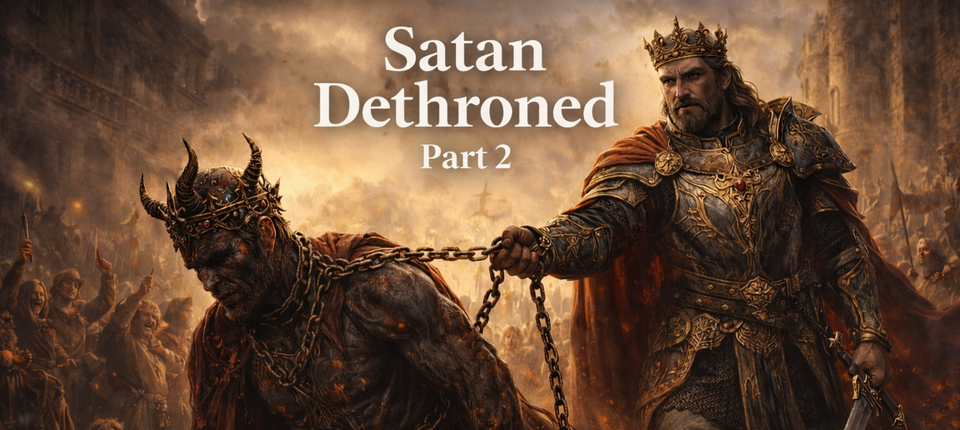
The Fall of the Accuser and the Authority of the New Creation
There are moments in Scripture where Jesus speaks in imagery so vivid that it captures the imagination, yet if we are not careful, we can carry those images into places they were never meant to go. One of those moments comes when Jesus describes something He witnessed, something His disciples would have immediately understood within the unfolding story of their time.
And He said unto them, I beheld Satan as lightning fall from heaven.
(Luke 10:18)
For many, this has been read as a distant, ancient event, something that took place long before humanity’s story truly began, or as an ongoing cosmic reality still playing out. But Jesus speaks of it in connection with what His disciples were experiencing in that very moment. They had just returned, amazed that even unclean spirits responded to them, and Jesus, rather than redirecting them to a future expectation, anchors their experience in a present reality. He describes the fall of Satan not as something far removed, but as something they were witnessing the effects of.
This begins to shift how we see the language of “heaven” in this context. Within the biblical story, heaven is not always a distant location, but often a way of describing authority, position, and covenantal standing. To fall from heaven, then, is to lose that place of authority. It is to be removed from the position where accusation once held power.
What the disciples were encountering was not the beginning of a long battle, but the visible evidence that something had already begun to collapse. The authority structure of accusation, condemnation, and spiritual opposition was being dismantled in the presence of Christ. The kingdom He carried was not coexisting with that system; it was displacing it.
This is why Jesus immediately reframes their excitement, redirecting their focus away from the manifestation of power and toward something far deeper.
Behold, I give unto you power to tread on serpents and scorpions, and over all the power of the enemy: and nothing shall by any means hurt you. Notwithstanding in this rejoice not, that the spirits are subject unto you; but rather rejoice, because your names are written in heaven. (Luke 10:19–20)
There is a tenderness in this correction. He does not deny the authority they have been given, but He refuses to let their identity be shaped by what they can do. Instead, He anchors them in where they now belong. Their names are written in heaven. Their standing has changed. Their place has shifted.
The emphasis moves from activity to identity, from power expressed to belonging secured.
And this becomes essential, because the new covenant reality is not built on managing darkness, but on living from a new position altogether.
The apostle John would later echo this same reality, not as a future hope, but as a present condition within the life of the believer.
I write unto you, young men, because you have overcome the evil one… I write unto you, young men, because you are strong, and the word of God abides in you, and you have overcome the evil one. (1 John 2:13–14)
Notice again the tense. Have overcome. This is not written to a group striving toward victory, but to a people who have already been brought into it. Their strength is not something they are trying to produce, but something that flows from what now abides within them. The word of God, the very life and reality of Christ, is not external to them, but present, active, and shaping them from within, as it says in Philippians,
for it is God who works in you, both to will and to do for his good pleasure. (Php 2:13)
To overcome the evil one, in this light, is not to win a daily battle against a present adversary, but to live in the awareness that the authority of that adversary has already been removed. It is to no longer be defined by accusation, no longer be governed by fear, and no longer interpret life through the lens of separation.
This is where the language of the apostles becomes deeply pastoral rather than confrontational. They are not equipping believers for an endless war; they are awakening them to a finished victory.
This same thread runs through the words of Paul as he reflects on the appearing of Christ and what it brought into the world.
Do not be ashamed of the testimony about our Lord… who saved us and called us to a holy calling, not according to our works, but according to His own purpose and grace… which now has been manifested through the appearing of our Savior Christ Jesus, who abolished death and brought life and immortality to light through the gospel. (2 Timothy 1:8–10)
Here again, the language is decisive. Death has been abolished. Life has been brought to light. What once held humanity in fear and uncertainty has been fully addressed in Christ. The gospel is not presenting the possibility of life; it is unveiling it. It is not offering a future escape; it is revealing a present reality.
And this begins to reshape how we understand authority itself.
When Jesus sent out His disciples and gave them power over unclean spirits, it was not merely a temporary empowerment for a specific mission. It was a sign, a visible expression of a greater transition taking place.
And when He had called unto Him His twelve disciples, He gave them power against unclean spirits, to cast them out, and to heal all manner of sickness and all manner of disease. (Matthew 10:1)
This authority was not rooted in their effort, nor in their spiritual maturity, but in their connection to Him. It flowed from relationship, from participation in what He was bringing into the world. And as the new covenant reality fully emerged, this authority was no longer about confronting an equal and opposing force, but about expressing the life of a kingdom in which that opposing force had already been judged and displaced.
For anyone walking through recovery or navigating a profound inner struggle, this perspective carries the potential to be truly liberating. It has the power to dismantle a framework that may have been reinforced for years, even decades. The belief that there is a powerful enemy constantly ruling, influencing, and controlling can unintentionally keep a person trapped in a posture of perpetual resistance: always fighting, always striving, always bracing for the next attack. By challenging that narrative, it opens the door to a different way of living: one marked by greater freedom, peace, and the possibility of genuine transformation.
Here is where the gospel introduces a different posture altogether.
It invites us to stand, not in defense, but in awareness.
To see that what once held authority has been removed.
To recognize that the patterns we wrestle with are not evidence of a reigning power, but remnants of an old way of seeing, thinking, and identifying; the residue of a carnal mind that has yet to be fully renewed. The struggle is not with an external force that rules over us, but with lingering thought patterns and false identities formed under your old ways of thinking.
This is why Paul prayed that believers would be enlightened and transformed in their understanding, and why he exhorted them "to be renewed in the spirit of your mind" (Ephesians 4:23). Likewise, he prayed that God would give them "the Spirit of wisdom and revelation in the knowledge of Him, the eyes of your understanding being enlightened" (Ephesians 1:17-18). True transformation comes not through endless resistance, but through awakening to what is already true in Christ and allowing the mind to be renewed accordingly.
And from this place, transformation begins to take on a different character. It becomes less about force and more about clarity. Less about resistance and more about renewal. Less about trying to overcome and more about learning to live from what has already been overcome.
Even Peter's warning in 1 Peter 5:8 that "your adversary the devil walks about like a roaring lion, seeking whom he may devour" takes on a different light from this perspective. The emphasis is not on a lion with unquestioned authority, but on one that roams like a lion, seeking those who remain vulnerable to lies, fear, deception, and an unrenewed consciousness. From an eighth-day reality, the reality of new creation and completed union in Christ, the question is no longer whether darkness is powerful enough to overcome us, but whether we will awaken to the truth of who we already are. What devours is not the strength of an enemy, but continued agreement with lies and accusations that obscure our inheritance. This is why Peter immediately follows his warning with the exhortation, "Whom resist steadfast in the faith" (1 Peter 5:9). The resistance is not a struggle to gain victory, but a steadfast refusal to abandon the truth. It is standing firm in the faith, anchored in the finished work of Christ and the reality revealed through God's Word.
As the mind is renewed and the eyes of the heart are enlightened (Ephesians 1:17-18), the roar loses its intimidation; what once appeared as a threat is recognized as powerless in the presence of revealed sonship. In this light, Peter's call to be sober and vigilant is not an invitation to fearfully scan the horizon for an approaching enemy, but to remain awake to the truth of Christ within, refusing to give place to anything that seeks to draw the heart back into the shadows of an old and passing consciousness. And if the lion does appear, the response is not panic but truth. The sword of the Spirit, which is the Word of God (Ephesians 6:17), is drawn from its sheath and cuts through every deception, every accusation, and every lie, exposing them in the light of what God has already declared to be true.
There is something profoundly steadying in this realization. The urgency begins to fade, the pressure begins to lift, and the constant sense of spiritual tension begins to give way to a quiet confidence. Not confidence in self, but in what has already been accomplished in Christ.
The fall of Satan is not an ongoing event we are waiting to see completed. It is a reality we are learning to see more clearly. The authority of the accuser has been removed, the place from which condemnation once spoke has been emptied, and what remains is not a contested throne, but an established kingdom that like leaven is working until that perfect day when all is comsumated.
And in that kingdom, your name is already written.
There is no striving here, no demand to prove anything, no pressure to secure what has already been given. There is only an invitation to rest into what is true, to allow the mind to be renewed, and to slowly awaken to the life that is already yours.
To live not as one trying to overcome, but as one who already has. As John wrote, "you have overcome the evil one" (1 John 2:13-14). The victory is not presented as a future possibility, but as a present reality. The call is not to strive for triumph, but to awaken to and abide in the triumph that is already yours in Christ.
If these messages have encouraged you, consider planting a seed. Your generosity helps continue this work and creates opportunities for others to grow and strengthen their faith.

Member discussion