Ruth: From the Fields of Moab to the Lineage of Christ
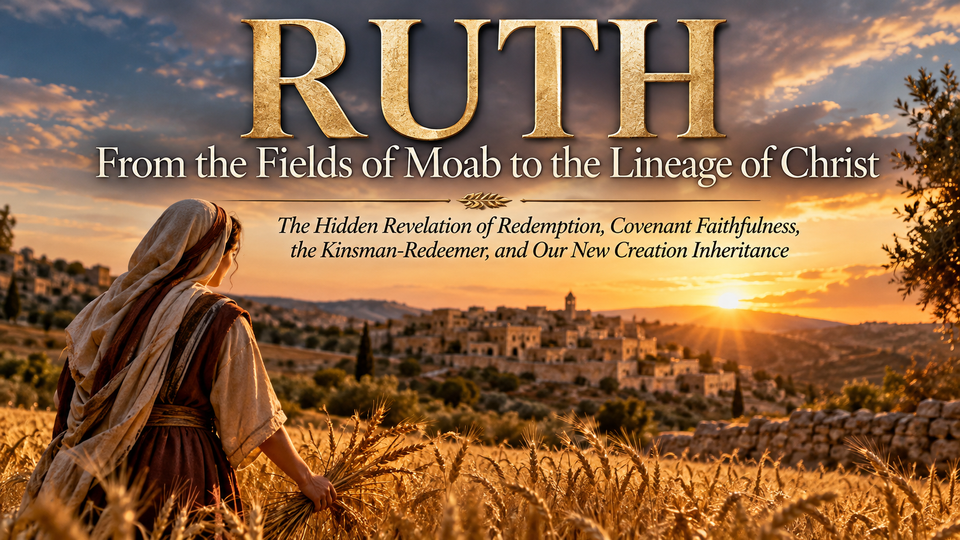
The Hidden Revelation of Redemption, Covenant Faithfulness, the Kinsman-Redeemer, and Our New Creation Inheritance
Introduction: There Is More to Ruth Than We Have Been Told
There are certain books of Scripture that we have read so many times that we begin to assume we already understand everything they have to say. The book of Ruth is one of them. Most Christians know the familiar story of a young Moabite widow who refused to abandon her mother-in-law, Naomi, and eventually married a wealthy and honorable man named Boaz. We have heard sermons about Ruth's loyalty, Naomi's bitterness, and Boaz's kindness. We have been taught that Ruth is a beautiful illustration of faithfulness and that Boaz foreshadows Jesus Christ, our Redeemer. All of these observations have value, but I believe there is something far greater unfolding beneath the surface of this remarkable four-chapter book.
Ruth is not merely the story of a woman finding a husband. It is a story about redemption, inheritance, covenant belonging, and the extraordinary faithfulness of God in bringing His redemptive purpose to fulfillment. It begins with famine, death, emptiness, and displacement, but ends with restoration, fruitfulness, and the birth of a child whose descendants would eventually lead to King David and ultimately to Jesus Christ. And here is what makes this story particularly remarkable: the woman through whom this royal lineage continues is not an Israelite by birth. She is a Moabite, a foreigner, someone whose ancestry placed her outside the ordinary boundaries of Israel's covenant community.
Yet this outsider becomes part of the family through whom the Messiah enters the world.
I want us to consider what that means, because the implications reach far beyond Ruth's personal circumstances. To appreciate the significance of this little book, we must understand the covenant laws concerning inheritance, redemption, and the inclusion of foreigners. We must examine why Boaz was qualified to act as a redeemer, why another relative stood before him, and why the story ends with a genealogy rather than simply a wedding. And finally, we must ask what all of this reveals about the finished work of Christ and the life we have been brought into through Him.
But I also want to bring something personal into this study. After more than thirty years of walking in recovery and ministering to people whose lives have been devastated by addiction, I have come to appreciate the language of redemption in ways I never could have understood merely by studying theological definitions. I have spent more than 5,000 hours sitting face-to-face with men whose lives have been marked by addiction, homelessness, incarceration, broken relationships, shame, and the overwhelming weight of regret. I have listened to men describe everything they have lost, and I have watched what happens when someone who believes his life is over begins to discover that his past does not have to determine his future.
And the more I read Ruth, the more I recognize something familiar in this ancient story. Naomi believes she has lost everything. Ruth faces a future filled with uncertainty. Neither woman can see what God is doing, and neither understands how their present circumstances will eventually become part of a story far greater than themselves.
Yet God is already working.
And when we follow this story all the way to Jesus Christ, we discover something wonderful. Redemption is not merely about recovering what was lost. In Christ, it is about being brought into a life that could never have existed apart from His death and resurrection.
The House of Bread Had No Bread
The opening words of Ruth establish the historical setting:
“In the days when the judges ruled, there was a famine in the land.” (Ruth 1:1)
The writer deliberately places this story during the period of the judges, one of the most turbulent eras in Israel's history. The closing words of Judges describe a people who repeatedly abandoned the ways of the Lord:
“Everyone did what was right in his own eyes.” (Judges 21:25)
Israel experienced cycles of covenant unfaithfulness, oppression, repentance, and deliverance. Yet in the middle of that troubled world, God was quietly working through the ordinary lives of a few seemingly insignificant people.
The story begins in Bethlehem, a name commonly understood to mean "house of bread." There is an irony here that should not escape our attention. A famine has struck the very place called the house of bread. Elimelech, whose name means "My God is King," leaves Bethlehem with his wife Naomi and their two sons, Mahlon and Chilion, seeking survival in the land of Moab. What began as a temporary journey eventually became a ten-year residence in a foreign land.
Moab carried a complicated history in Israel's Scriptures. The Moabites descended from Lot through the tragic events recorded in Genesis 19. They had opposed Israel during the wilderness journey, and Deuteronomy 23:3–6 placed severe restrictions upon their admission into the assembly of the Lord. Yet the book of Ruth introduces us to a Moabite woman whose faithfulness becomes one of the most beautiful examples of covenant loyalty in the entire Old Testament.
This should immediately challenge our assumptions about how God works. While Israel's national history was filled with conflict and disobedience, God was preparing a woman from outside Israel to participate in the unfolding history of redemption. The narrative does not erase Israel's covenant identity or pretend that the distinctions established under Moses never existed. Rather, it shows God's mercy operating in a way that would ultimately anticipate the greater inclusion accomplished through Christ.
And here is something I want us to recognize from the beginning. The story of Ruth is not primarily about God abandoning Israel and finding someone else to take her place. It is about God faithfully advancing His promises through Israel while revealing that His ultimate purpose would extend far beyond Israel's national boundaries.
When God called Abraham, He promised that through him all the families of the earth would be blessed (Genesis 12:3). That promise was never intended to terminate upon Abraham's physical descendants alone. Israel was the covenant nation through whom the promised Seed would come, but the blessing of that Seed was always destined to reach the nations.
Paul eventually identifies that promised Seed as Christ (Galatians 3:16).
And long before the apostle Paul explained this mystery, God was already weaving a Moabite woman into the ancestry of the coming Messiah.
Naomi's Emptiness: When Our Circumstances Become Our Identity
The opening chapter quickly moves from famine to tragedy. Elimelech dies, leaving Naomi with her two sons. The sons marry Moabite women, Orpah and Ruth, but eventually both sons die as well. Naomi is left without her husband and without her children, and her daughters-in-law are left widowed.
In the ancient world, this was more than emotional devastation. It was an economic and social catastrophe. A widow without sons or adequate family protection could face extraordinary vulnerability. Land, inheritance, provision, and the preservation of a family name were closely connected to the household structure of Israel. Naomi's losses threatened not only her immediate security but the future of her husband's family.
When Naomi hears that the Lord has visited His people by giving them bread, she decides to return to Bethlehem. She encourages her daughters-in-law to remain in Moab, where they might remarry and establish new households. Orpah eventually returns, but Ruth refuses to leave.
“Do not urge me to leave you or to turn back from following you. For wherever you go, I will go, and wherever you live, I will live; your people will be my people, and your God will be my God. Where you die, I will die, and there I will be buried.” (Ruth 1:16–17)
These words are frequently quoted at weddings, but their original setting is not a marriage ceremony. They are a declaration of covenant loyalty. Ruth is binding herself to Naomi, to Naomi's people, and most importantly, to the God of Israel. She is leaving behind her former homeland and embracing a future that offers no obvious guarantee of security or prosperity.
The Hebrew word hesed, often translated as kindness, steadfast love, or covenant faithfulness, is central to understanding this book. It describes a love that expresses itself through loyalty and action rather than mere sentiment. Ruth demonstrates this quality through her commitment to Naomi, and Boaz later recognizes it in her conduct.
But when Naomi returns to Bethlehem, her grief has become so overwhelming that she no longer wants to be identified by her original name.
“Do not call me Naomi. Call me Mara, because the Almighty has dealt quite bitterly with me. I went away full, but the LORD has brought me back empty.” (Ruth 1:20–21)
Naomi, whose name is associated with pleasantness, now wishes to be called Mara, meaning bitter. She interprets her entire life through the pain of her losses. She left Bethlehem with a husband and two sons, but returns without them. From her perspective, everything has been taken away.
And this is where I want to pause for a moment, because after more than thirty years in recovery and ministry, I have come to recognize something in Naomi's words that reaches far beyond this ancient story.
I have spent thousands of hours sitting across from men whose lives have been devastated by addiction. Men who have lost marriages, relationships with their children, careers, homes, freedom, and sometimes nearly every meaningful connection they once possessed. I have listened to stories of regret that would break your heart. I have watched grown men struggle to speak through their tears as they remembered the people they hurt and the years they could never recover. And I cannot tell you how many times I have heard the same sentiment Naomi expressed, even though the words were different: "I went out full, and I came back empty."
But something I have learned through those countless conversations is that people often confuse the condition of their circumstances with the condition of their identity. They begin to believe that because they have lost everything, they have become nothing. Their addiction becomes their name. Their failures become their identity. Their past becomes the only future they can imagine. And once a person begins to believe that his past is the truest thing about him, he can spend the rest of his life imprisoned by something that has already happened.
This is one reason the revelation of our identity in Christ has become so central to everything I teach. I am not interested merely in convincing people that they can become better versions of the people they used to be. I want them to discover what God has accomplished through Jesus Christ. I want them to understand that their history is real, and their choices may have consequences, but neither possesses the authority to determine who they are in Him.
Now look again at Naomi. She declares that she has returned empty, but standing right beside her is Ruth. The very woman through whom God will begin restoring her household is already walking alongside her. Naomi cannot yet recognize the significance of what she still possesses because her attention is fixed upon everything she has lost.
How often do we do the same thing? We look at our circumstances and conclude that God has abandoned us because we cannot see what He is doing. We interpret His faithfulness through our present experience rather than interpreting our experience through His faithfulness.
And then the chapter ends with a seemingly ordinary observation.
“So Naomi returned from the land of Moab with her daughter-in-law Ruth the Moabitess. And they arrived in Bethlehem at the beginning of the barley harvest.” (Ruth 1:22)
What an extraordinary detail. Naomi has returned believing herself to be empty, but she has arrived at the beginning of harvest. The famine has ended, the fields are producing grain, and the means of restoration are already present before Naomi understands what is happening.
I have sat with men who were so consumed by what they had lost that they could not recognize the grace standing right in front of them. Sometimes one of the most important things we can do for another person is help him see beyond the ruins of yesterday and begin to recognize what God has made available to him right now and in this very moment.
And here is something worth remembering.
You may have lost everything that once defined your life, but that does not mean you have lost the possibility of discovering who you truly are in Christ.
Ruth's Decision: Leaving One World and Entering Another
Ruth's decision to accompany Naomi deserves more attention than we often give it. She is not merely relocating to another country. She is leaving behind the familiar world of Moab and placing herself among a people whose customs, covenant laws, and religious practices are different from those of her upbringing.
Her confession is extraordinary:
“Your people will be my people, and your God will be my God.” (Ruth 1:16)
This is a declaration of allegiance. Ruth is identifying herself with the God of Israel and the people of His covenant. She does not know what awaits her in Bethlehem. She has no guarantee that she will remarry, possess property, or find financial security. Yet she commits herself to a future grounded in the God whom Naomi worships.
There is a beautiful spiritual principle here, although we must be careful not to confuse Ruth's historical experience with the full reality of New Covenant regeneration. Ruth entered Israel's covenant community under the circumstances of her own time. The believer in Christ experiences something greater than a change of national or religious allegiance.
Paul declares:
“Therefore if anyone is in Christ, he is a new creation. The old has passed away. Behold, the new has come!” (2 Corinthians 5:17)
Notice what Paul does not say. He does not say that if any man is in Christ, he has become a slightly improved version of his former self. He does not say that the old man remains alive and must spend the rest of his existence competing with a new man for control. He declares that the person in Christ is a new creation.
Romans 6:6 explains the foundation of this reality:
“We know that our old self was crucified with Him so that the body of sin might be rendered powerless, that we should no longer be slaves to sin.” (Romans 6:6)
The word translated "destroyed" does not mean that our physical bodies or our capacity to experience temptation have ceased to exist. It carries the sense of being rendered powerless or brought to an end in its former controlling function. Paul's point is that the believer's old identity under sin's dominion has been decisively dealt with through union with Christ.
This is where we must distinguish between our new identity and the ongoing renewal of our minds. Becoming a new creation does not mean that every unhealthy habit, destructive thought pattern, emotional wound, or learned behavior immediately disappears. Anyone who has spent significant time working with people in recovery understands that rebuilding a life involves learning, discipline, accountability, healing, and perseverance.
But those processes are not what make someone a new creation. They are part of learning to live consistently with the new life received in Christ.
And that distinction changes everything.
Ruth's journey illustrates the importance of leaving behind one allegiance and embracing another. But the Gospel takes us further. In Christ, we have not merely entered another community. We have been joined to the risen Son of God.
Our new life is not simply a better destination.
It is participation in a new creation.
The Field of Boaz: Grace Was Already Waiting
Chapter two introduces Boaz, a wealthy and influential relative of Elimelech. Ruth asks Naomi for permission to go into the fields and glean among the harvested grain. This practice was not simply an act of generosity invented by individual landowners. It was part of the provision established in the Law of Moses.
Leviticus 19:9–10 and Deuteronomy 24:19–22 instructed Israel not to harvest every corner of the field or gather every remaining portion of the crop. These provisions were intended for the poor, the stranger, the fatherless, and the widow. In other words, God's covenant law included practical provisions for those who lacked the ordinary means of sustaining themselves.
Ruth enters the field as both a widow and a foreigner, precisely the kind of vulnerable person these commands were designed to protect.
The narrative tells us that she happened to come upon the portion of the field belonging to Boaz. From the human perspective, it appears to be an ordinary circumstance. Ruth simply goes out looking for food. Yet the reader begins to recognize the providence of God working through ordinary decisions and relationships.
Boaz notices Ruth and asks about her identity. When he learns who she is and how faithfully she has cared for Naomi, he extends extraordinary kindness toward her. He tells her to remain in his fields, instructs his young men not to trouble her, provides water for her, and later commands his workers to leave additional grain for her to gather.
Listen to his blessing.
“May the LORD repay your work, and may you receive a rich reward from the LORD, the God of Israel, under whose wings you have taken refuge.” (Ruth 2:12)
That phrase, "under whose wings thou art come to trust," is particularly beautiful. Ruth has sought refuge under the protection of Israel's God. The image of God's wings appears elsewhere in the Psalms as a picture of divine shelter and covenant care.
But there is something else I want us to notice. Ruth is receiving kindness before she fully understands the role Boaz will eventually play in her redemption. She knows him as a generous landowner before she knows him as a possible redeemer.
What a beautiful illustration of the grace revealed in Jesus Christ.
John tells us:
“We love because He first loved us.” (1 John 4:19)
Paul declares that God demonstrated His love toward us while we were still sinners (Romans 5:8). The initiative of divine love did not begin with humanity successfully finding its way back to God. It began in the heart and purpose of God Himself.
And yet, notice that Ruth's experience of grace did not produce passivity. She worked diligently in the field. She acted responsibly. She honored Naomi. Grace and faithful action were not enemies.
This is important because sometimes Christians misunderstand grace as though it means our actions no longer matter. But grace does not eliminate the significance of obedience, love, service, and responsibility. It changes the foundation from which those things proceed.
Under the New Covenant, we do not obey in order to persuade God to love us. We love because He first loved us. We do not pursue righteousness to manufacture an identity that Christ has not yet given us. We learn to walk in the righteousness and life we have received through Him.
The difference is not merely behavioral.
It is relational.
The Kinsman-Redeemer: Redemption Required Someone Who Belonged to the Family
To understand the heart of Ruth, we must examine the Hebrew concept of the goel, commonly translated as a kinsman-redeemer.
Under Israel's covenant law, certain family responsibilities were assigned to close relatives. Leviticus 25:25 describes the responsibility of a near relative to redeem family land that had been sold because of poverty. Other passages describe additional responsibilities connected with family protection and the preservation of inheritance.
The word goel comes from a Hebrew root associated with redeeming, reclaiming, or acting on behalf of a relative. It is a rich term, but we should recognize that its responsibilities varied according to the legal situation. Not every responsibility of a redeemer was identical.
In Ruth, the redemption of family property becomes connected with marriage and the preservation of the deceased husband's name. The story draws upon Israel's inheritance customs and reflects concerns similar to those found in the levirate marriage law of Deuteronomy 25:5–10, although Boaz's situation is not a straightforward application of that law. Boaz is a relative, not the deceased husband's brother, and the narrative combines family redemption and marriage in a distinctive way.
This matters because the writer is not merely describing a romantic relationship. He is showing us how redemption restores what was in danger of being lost.
Boaz possesses the standing and resources necessary to act on behalf of Naomi's family. Yet there is another relative who has a prior claim. Boaz cannot simply ignore the established order. He must address the matter publicly and lawfully.
Now consider the greater redemptive work of Jesus Christ.
“Now since the children have flesh and blood, He too shared in their humanity, so that by His death He might destroy him who holds the power of death, that is, the devil.” (Hebrews 2:14)
The incarnation is central to our redemption. The eternal Son truly entered our humanity. He did not redeem humanity from a distance, as though He were merely an outside observer. He became flesh and blood, entering the condition of those He came to save.
Hebrews 2:17 continues by explaining that He was made like His brethren so that He might become a merciful and faithful High Priest.
Now I want us to consider something that is often overlooked when discussing the humanity of Jesus. We readily confess that He is God, and rightly so. But sometimes we emphasize His deity in such a way that we almost forget the extraordinary significance of His genuine humanity. Jesus did not merely appear to be human. He entered our humanity, experienced its weakness without sin, and walked in perfect communion with the Father as the obedient Son.
He came not only to reveal the Father to us but to bring us into the relationship with the Father that His redemptive work would make possible.
This is why the incarnation, crucifixion, resurrection, and our union with Christ cannot be separated from one another. The Son entered our humanity, bore our sin, died our death, and rose again as the beginning of a new creation.
And through Him, we have been brought into the household of God.
Ephesians 2:19 declares that believers are no longer strangers and foreigners, but fellow citizens with the saints and members of God's household.
Think about that for a moment. Boaz could act as a redeemer because he belonged to the family. Jesus became our brother according to the flesh and accomplished a redemption far greater than the recovery of earthly property.
Boaz restored an endangered family inheritance.
Christ brought us into the family of the Father Himself.
The Threshing Floor: The Covering of the Redeemer
Chapter three brings us to one of the most intriguing scenes in the entire narrative. Naomi instructs Ruth to approach Boaz at the threshing floor after he has finished eating and drinking and has lain down to sleep. Ruth follows her instructions, and when Boaz awakens during the night, he discovers Ruth lying at his feet.
He asks who she is, and she responds:
“I am your servant Ruth, she replied. Spread the corner of your garment over me, for you are a kinsman-redeemer.” (Ruth 3:9)
The Hebrew expression translated "skirt" refers to the wing or extremity of a garment. Remarkably, it is related to the word used in Ruth 2:12, where Boaz spoke of Ruth taking refuge under the wings of the Lord.
Earlier, Boaz had blessed Ruth for seeking refuge beneath God's wings. Now Ruth asks Boaz to extend the covering of his own garment over her as her redeemer.
The imagery is beautiful. Ruth is asking Boaz to become the human instrument through whom the covenant protection she has sought from God might be expressed.
This is not simply a request for financial assistance. It is a request for marriage and redemption. Ruth is asking Boaz to take responsibility for the family situation that has left Naomi and herself vulnerable.
Notice also how Boaz responds. He does not condemn Ruth or exploit her vulnerability. He honors her faithfulness and acknowledges her request. Yet he also recognizes that another relative possesses a prior right of redemption. He promises to address the matter properly.
We should be cautious about turning every detail of the threshing floor into an elaborate prophetic code. Scripture does not explicitly identify the threshing floor as a symbol of the cross, nor does it teach that Ruth's actions represent a prescribed formula for approaching Christ. Nevertheless, the central image of seeking covenant protection through a qualified redeemer is profoundly consistent with the greater redemptive story.
Through Jesus Christ, we have received something more enduring than the covering of a garment. We have been clothed with Christ Himself.
“For all of you who were baptized into Christ have clothed yourselves with Christ.” (Galatians 3:27)
This is the language of participation and identification. Paul is not describing a superficial religious covering that leaves the believer fundamentally unchanged. He is describing a new relationship with Christ in which our identity is inseparably connected to Him.
And this is where I believe much of modern Christianity has lost sight of the Gospel's extraordinary announcement. We have often presented salvation as though Jesus merely provided forgiveness so that we could continue living as fundamentally unchanged people, constantly struggling to earn God's acceptance.
But Paul presents something far greater.
We have been crucified with Christ. We have been raised with Him. We have been made alive together with Him. And we have been brought near to the Father through Him.
The Christian life is not an endless attempt to persuade God to receive us into His household. Through Christ, He has already opened the way of reconciliation and brought believers near.
We do not stand outside the family begging for a place at the table.
In Christ, we belong to the household.
The Nearer Redeemer: Why the Law Could Not Give Life
When Boaz approaches the city gate in chapter four, he meets the relative who has the first right to redeem the family property. At first, this man expresses willingness to redeem the land. But when Boaz explains that the matter also involves Ruth and the preservation of the deceased husband's name, the relative declines, fearing that the obligation would endanger his own inheritance.
Boaz then publicly accepts the responsibility before the elders and witnesses.
This scene has often been interpreted typologically, with the nearer redeemer representing the Law of Moses and Boaz representing Christ. There is an interesting theological comparison here, but we should distinguish between what Ruth explicitly teaches and what we may draw as a broader canonical illustration. The unnamed relative is not identified in the text as Moses or the Law, and his refusal is based upon concerns about inheritance rather than an inability to remove sin.
Still, when we turn to the New Testament, we discover a genuine theological distinction between the Law and the redemptive work of Christ.
“For what the law was powerless to do in that it was weakened by the flesh, God did by sending His own Son in the likeness of sinful flesh, as an offering for sin. He thus condemned sin in the flesh, so that the righteous standard of the law might be fulfilled in us, who do not walk according to the flesh but according to the Spirit.” (Romans 8:3–4)
The Law was holy, just, and good (Romans 7:12). Its weakness did not arise from some moral defect in God's commandments, but from the condition of fallen humanity. The Law could identify sin, reveal righteousness, and regulate Israel's covenant life, but it could not impart resurrection life or perfect the conscience of the worshiper.
Hebrews 10:1–4 makes this especially clear. The repeated sacrifices of the Old Covenant could not accomplish the final removal of sin. They pointed beyond themselves toward the one sacrifice that would bring the sacrificial system to its intended fulfillment.
Jesus Christ did not come to compete with the Law as though God had made a mistake in giving it. He came to fulfill the Law and the Prophets (Matthew 5:17).
And that fulfillment changes everything.
Under the former covenant, Israel's relationship with God was administered through a system of priesthood, sacrifices, ordinances, and covenant boundaries. Under the New Covenant, the true High Priest has offered Himself once for all, opened the way into the heavenly sanctuary, and brought His people into the reality toward which the earlier institutions pointed.
The Law could testify to the need for redemption. Christ accomplished redemption.
The Law could describe righteousness. Christ brings believers into a living union in which righteousness becomes the fruit of His life within them.
The Law could expose the problem of sin. Christ dealt with sin through His own sacrifice.
And when we understand this, we begin to see why returning to an identity defined by the old covenant administration is not spiritual progress. It is a failure to recognize the fullness of what has been accomplished in the Son.
Redemption at the Gate: The Work Was Publicly Accomplished
In Ruth 4, Boaz gathers the elders and publicly declares his intention to redeem the property belonging to Elimelech's family and to take Ruth as his wife.
“You are witnesses today that I have bought from Naomi all the property of Elimelech, Chilion, and Mahlon. Moreover, I have acquired Ruth the Moabitess, Mahlon’s widow, as my wife, to raise up the name of the deceased on his inheritance.” (Ruth 4:9–10)
The public nature of this transaction is important. Redemption is not merely a private sentiment or an unverified promise. It is an established act witnessed by the community.
In the greater story of salvation, the redemptive work of Christ was accomplished through His historical death and resurrection. Paul does not present reconciliation as something that becomes objectively true only when an individual experiences a particular emotion or reaches a certain level of spiritual maturity.
He writes:
“God was reconciling the world to Himself in Christ, not counting men’s trespasses against them. And He has committed to us the message of reconciliation.” (2 Corinthians 5:19)
The apostles proclaimed an accomplished work and called people to receive and live in the reconciliation Christ had established. Paul continues:
“We implore you on behalf of Christ: Be reconciled to God.” (2 Corinthians 5:20)
Here we must distinguish between the accomplishment of redemption and our personal participation in its benefits through faith. The New Testament does not treat these as identical statements, nor does it reduce redemption to a mere change in our awareness. Christ truly acted in history. His death and resurrection are the foundation of our reconciliation.
But once we are united to Him through faith, our identity is no longer determined by the condition from which He redeemed us.
Paul declares in Colossians 1:13–14 that God has delivered us from the authority of darkness and translated us into the kingdom of His beloved Son, in whom we have redemption and the forgiveness of sins.
Notice the language. He has delivered us. He has translated us. We have redemption.
This is not the language of an indefinitely postponed spiritual reality. It is the language of an accomplished transfer of belonging and authority.
And that is why I continually return to the importance of our identity in Christ. We cannot consistently live from a redemption we refuse to believe has actually taken place. If we continue to define ourselves primarily by the old man, the former bondage, and the separation from which Christ has delivered us, we will inevitably attempt to live the Christian life through the very identity that Scripture declares was crucified with Him.
The old man was not sent to religious rehabilitation.
He was crucified with Christ.
Ruth the Moabite: When the Outsider Becomes Family
Perhaps one of the greatest revelations in Ruth is found in the repeated identification of Ruth as "the Moabitess." The writer never allows us to forget her background. Even at the moment of redemption, Boaz publicly identifies her as Ruth the Moabitess.
Why does this matter?
Because the story is not simply about restoring an Israelite family. It is also about the inclusion of a foreign woman within the lineage through which God's covenant promises would continue.
Deuteronomy 23:3 raises an important interpretive question concerning the Moabites and their admission into the assembly of the Lord. Scholars have long discussed how that restriction relates to Ruth's acceptance into Israel, including whether the prohibition concerned particular forms of assembly membership, how its generational language should be understood, and how Ruth's confession of allegiance to Israel's God affects the situation. The book of Ruth does not provide a formal legal explanation resolving every question.
What it does show is that Ruth is received, honored, married, and ultimately incorporated into the genealogy of David.
Now consider the significance of this in light of the New Testament.
Paul explains in Ephesians 2 that Gentiles were once strangers from the covenants of promise, without hope and without God in the world. Yet through the blood of Christ, those who were far off have been brought near.
“For He Himself is our peace, who has made the two one and has torn down the dividing wall of hostility by abolishing in His flesh the law of commandments and decrees. He did this to create in Himself one new man out of the two, thus making peace, and to reconcile both of them to God in one body through the cross, by which He extinguished their hostility.” (Ephesians 2:14–16)
This is where the story of Ruth begins to shine with extraordinary significance.
Ruth's inclusion anticipates the blessing of the nations, but Christ brings that purpose to its full covenantal realization. The dividing wall is broken down, and Jew and Gentile are reconciled to God in one body through the cross.
The Church is not a foreign institution that arrived to replace Israel after God abandoned His original purpose. Rather, the New Covenant people of God emerge through the fulfillment of the promises made to Israel, beginning with the faithful Jewish remnant who received Israel's Messiah and expanding to include believing Gentiles grafted into the same cultivated olive tree, as Paul explains in Romans 11.
There is one Redeemer, one Spirit, one household, and one new humanity in Christ.
And this new humanity is not organized around the superiority of one ethnic identity over another. It is established in the crucified and risen Son.
Ruth was no longer defined merely by the land from which she came. Her future was bound to the covenant family into which she had been received.
How much more should this be true of those who have been made new creations in Jesus Christ?
From Emptiness to Fullness: The Birth of Obed
The final chapter of Ruth brings the story to its joyful conclusion. Boaz marries Ruth, and the Lord grants her conception. She gives birth to a son named Obed.
The women of Bethlehem then speak to Naomi.
“Blessed be the LORD, who has not left you this day without a kinsman-redeemer. May his name become famous in Israel. He will renew your life and sustain you in your old age.” (Ruth 4:14–15)
Naomi, who once declared that she had returned empty, now holds the child through whom her family receives a renewed future. The woman who wanted to be called Mara is surrounded by a community celebrating the faithfulness of God.
But the writer does not end the story with Naomi's personal restoration. Instead, he concludes with a genealogy.
Obed becomes the father of Jesse, and Jesse becomes the father of David.
Why would a book centered upon a widow and a foreign daughter-in-law conclude with the ancestry of a king?
Because the writer wants us to understand that these ordinary events were participating in a much greater historical purpose. The birth of Obed was not merely the restoration of one family. It was a significant moment in the ancestry of Israel's royal house.
And when Matthew opens his Gospel, he carries that genealogy forward to Jesus Christ.
“Salmon was the father of Boaz by Rahab, Boaz the father of Obed by Ruth, Obed the father of Jesse, and Jesse the father of David the king.” (Matthew 1:5–6)
There she is. Ruth the Moabite, named in the genealogy of Jesus Christ.
The woman who once gathered leftover grain in another man's field became an ancestor of the King through whom the nations would be blessed.
What a testimony to the faithfulness of God.
The significance of Ruth's inclusion is not that human faithfulness can earn a place in the Messianic lineage. It is that God was carrying forward His promise through people and circumstances that human expectation might easily have overlooked.
The same God who promised Abraham that all the families of the earth would be blessed through him was working through the lives of Naomi, Ruth, and Boaz to bring that promise closer to its fulfillment.
And ultimately, that promise finds its center in Christ.
The Greater Son of David and the Dawn of the Eighth Day
Now we arrive at the point where the story of Ruth opens into the fullness of New Covenant revelation.
The book concludes by directing our attention toward David. But David was not the final destination of God's redemptive purpose. The prophets announced that a greater Son of David would arise, One whose kingdom would be established in righteousness and whose reign would not come to an end.
Isaiah 9:7 declares that of the increase of His government and peace there shall be no end. Gabriel announces to Mary in Luke 1:32–33 that Jesus will receive the throne of His father David and reign over the house of Jacob forever.
And Peter, preaching on the Day of Pentecost, declares that the resurrection and exaltation of Jesus fulfilled the promise concerning David's royal descendant (Acts 2:29–36).
This is the kingdom toward which the genealogy of Ruth ultimately points.
But the revelation does not end with the enthronement of the King. It extends to the creation of a new humanity in Him.
Paul identifies Jesus as the last Adam and the second man in 1 Corinthians 15:45–47. The first Adam became the head of humanity in its fallen condition, while Christ, through His death and resurrection, became the source of resurrection life for those who belong to Him.
The old creation order, characterized by Adam's sin and death, finds its answer in the risen Christ.
This is where the language of the Eighth Day becomes so meaningful.
Throughout Scripture, the number eight is associated in various settings with a new beginning. Circumcision was performed on the eighth day (Leviticus 12:3). The Feast of Tabernacles included a solemn assembly on the eighth day (Leviticus 23:36). And Jesus rose from the dead on the first day of the week, a day early Christian writers sometimes described symbolically as the eighth day, the beginning of the new creation.
We should recognize that Ruth itself does not mention the eighth day or explicitly establish this symbolism. The connection is theological, arising from the larger biblical story of redemption and resurrection.
Nevertheless, the movement from loss to restoration, from threatened inheritance to renewed family, and from the foreigner's vulnerability to covenant belonging provides a beautiful illustration of the greater transition accomplished in Christ.
Under the New Covenant, we are not waiting for the last Adam to accomplish His redemptive work. He has already come. He has died. He has risen. He has been enthroned.
And through Him, the promised new creation has been inaugurated.
We are not standing in the fields of an unfinished redemption, waiting for our Redeemer to arrive. We belong to the risen Christ, in whom redemption has been accomplished.
The Inheritance Is No Longer Merely a Field
One final revelation deserves our attention.
The central concern of Ruth's redemption involves the preservation of family property, family identity, and the continuation of a name in Israel. The inheritance is connected to land and descendants within the covenant world of ancient Israel.
But when we come to the New Testament, the language of inheritance expands dramatically.
Paul writes in Ephesians 1:11 that in Christ we have obtained an inheritance. He explains in verses 13–14 that the Holy Spirit is the guarantee of that inheritance until the redemption of God's possession.
Peter speaks of an inheritance that is incorruptible, undefiled, and unfading, reserved in heaven for believers (1 Peter 1:3–4).
And Romans 8:16–17 declares that the Spirit bears witness with our spirit that we are children of God, and if children, then heirs, heirs of God and joint heirs with Christ.
Do we understand what this means?
The inheritance promised to believers is not simply the recovery of something Adam once possessed. It is participation in the life and sonship of the risen Christ. We have been brought into the family of the Father through the Son and given the Spirit of adoption by whom we cry, "Abba, Father."
This is why our identity in Christ is so important. We are not merely forgiven outsiders who have been permitted to stand near the family estate. We are sons and daughters who have been welcomed into the household and made heirs with Christ.
And the Spirit is not given merely as a temporary visitor who occasionally arrives to assist us. He dwells within us as the Spirit of the risen Son.
Paul declares:
“And because you are sons, God sent the Spirit of His Son into our hearts, crying out, “Abba, Father!”” (Galatians 4:6)
Notice the order. Because you are sons, God has sent forth the Spirit of His Son into your hearts.
The Christian life is therefore not an attempt to become acceptable enough to qualify for sonship. It is learning to live from the sonship we have received through Jesus Christ.
This is the difference between religious striving and New Covenant participation. Religion continually measures the distance between humanity and God and then offers methods for reducing that distance. The Gospel announces that Christ has reconciled us to the Father and calls us to live in the reality of that reconciliation.
We do not imitate Christ from a position of separation, trying to manufacture His character through our own independent strength. We abide in Him, and His life bears fruit through us.
Jesus said:
“Remain in Me, and I will remain in you.” (John 15:4)
And John declares:
“In this way, love has been perfected among us, so that we may have confidence on the day of judgment; for in this world we are just like Him.” (1 John 4:17)
That is not merely a promise about who we might become after physical death. It is a statement concerning the believer's present standing in Christ, particularly in relation to confidence before judgment. From that established identity flows the ongoing transformation of our thoughts, conduct, and relationships.
Thirty Years of Recovery: Why Identity Matters More Than We Realize
I want to return to something personal before bringing this study to a close, because there is a reason the revelation of our new identity in Christ has become so important to me. After more than three decades in recovery and ministry, there is one thing I have become increasingly convinced of: you can spend years teaching someone how to manage his behavior without ever helping him discover who he is. You can teach a man how to avoid certain places, distance himself from destructive relationships, establish healthy routines, and make better decisions. Those things are valuable, and in recovery they can be absolutely necessary. But if that man continues to believe that his deepest identity is the person he used to be, he may spend the rest of his life fighting to escape someone he believes he will always remain.
I have listened to men describe themselves almost exclusively through the language of their failures. They tell me they are addicts, criminals, disappointments, or men who have ruined everything they touched. And while I would never minimize the seriousness of addiction or the damage our choices can inflict upon others, I have come to understand that constantly rehearsing our former identity can become its own kind of bondage. We can become so accustomed to describing ourselves by what we were that we struggle to believe what God says we have become.
This is why the revelation of our union with Christ has become so central to everything I teach. I want people to understand that Jesus did not die merely to give us a second chance at living the old life more successfully. He died and rose again to bring us into an entirely new life. Paul did not say, "If any man be in Christ, he is a recovering old creation." He said:
“Therefore if anyone is in Christ, he is a new creation. The old has passed away. Behold, the new has come!” (2 Corinthians 5:17)
And I believe this is something the Church desperately needs to recover. We have become very skilled at reminding people what they were saved from, while sometimes failing to teach them who they have become in the One who saved them.
Now please understand what I am saying, because this is important. I am not suggesting that a person who has struggled with addiction should abandon recovery meetings, accountability, professional treatment, healthy boundaries, or the practical disciplines that support lasting recovery. Nor am I suggesting that believing our identity in Christ automatically removes every temptation, emotional struggle, or consequence of past decisions. The renewing of our minds is an ongoing process, and learning to walk consistently with the life of Christ requires maturity, wisdom, and perseverance.
But there is a tremendous difference between pursuing healing because we believe we are fundamentally broken beyond redemption and pursuing healing because we believe Christ has made us new.
One approach continually looks backward to determine who we are. The other begins with what Christ has accomplished and learns to walk forward from that reality.
And this is why Ruth's story speaks so powerfully to me. She could have remained forever identified as a poor Moabite widow, a woman whose husband had died and whose future appeared uncertain. That was her history, but it was not the end of her story. She became part of the family through whom the Messiah would come. And while her circumstances were certainly different from those of the men I have worked with, the lesson is one I never want us to overlook.
Our past is real, but it is not sovereign. Our mistakes may have consequences, but they do not possess greater authority than the redemptive work of Jesus Christ.
And perhaps that is why, after all these years, I still find such joy in sitting with someone who believes his life is over and opening the Scriptures with him. Because I know what it is to have a past that seemed impossible to escape. I also know what it means to discover that the life of Christ is greater than the life I once knew.
After thirty years of recovery and thousands of hours listening to broken men tell their stories, I have come to believe that one of the greatest tragedies in Christianity is not that people have a past, but that so many have never been taught that in Christ, their past is no longer their identity.
And that brings us back to Ruth.
Conclusion: The Redeemer Has Come, and the Inheritance Is Ours
When we return to the opening chapter of Ruth, we can now appreciate the extraordinary journey the writer has taken us through. A family leaves Bethlehem because of famine. Death empties a household. A grieving widow returns home believing that everything has been lost. A foreign woman chooses the God of Israel and follows her mother-in-law into an uncertain future. She enters a field seeking enough grain to survive, encounters a gracious relative, and eventually becomes the wife of a redeemer who restores the family's threatened inheritance.
Then, almost unexpectedly, the narrative reveals that their son will become the grandfather of David.
And generations later, the Son of David will enter the world.
What appeared to be a small story about the survival of two widows was woven into the great story of redemption.
But the greater revelation is not simply that Ruth eventually became part of Jesus' ancestry. It is that the Redeemer who came through that ancestry accomplished what no earthly kinsman-redeemer could ever accomplish.
Boaz could redeem property and preserve a family name. Jesus Christ redeemed His people from sin and death and brought them into the life of God.
Boaz could provide protection for Ruth and Naomi. Jesus has brought us into a covenant established upon better promises.
Boaz could restore an earthly inheritance. Jesus has made us heirs of God and joint heirs with Himself.
Boaz could welcome a foreign woman into his household. Jesus has broken down the dividing wall and created one new humanity in Himself.
And while Ruth's story ends with the birth of a child who would lead to David, the Gospel announces the resurrection of David's greater Son, the One through whom the promise to Abraham reaches the nations.
This is why we must learn to read the Scriptures through the revelation of Jesus Christ. Not by ignoring their historical meaning or inventing hidden symbols in every verse, but by recognizing the unified testimony of God's redemptive purpose.
The same God who was faithful to Naomi and Ruth has revealed the fullness of His faithfulness in Jesus Christ.
And now, in this New Covenant age, our calling is not to live as though redemption remains an unfinished possibility. It is to awaken to the reality of what Christ has accomplished and to walk in the life He has given us.
We are not foreigners standing outside the household. We are fellow citizens with the saints.
We are not slaves attempting to earn an inheritance. We are children of God.
We are not the old man struggling to become a new creation. In Christ, the old man has been crucified, and a new creation has come.
And we are not waiting for the Son of David to become King. He is risen, exalted, and reigning.
Ruth entered the field looking for bread. She found a redeemer who brought her into his household. We have found the Bread of Life Himself, and through Him we have been brought into the household of the Father.
And perhaps this is the greatest lesson I have learned through all these years of walking with people who are trying to rebuild their lives. Redemption is not merely about getting back what we once had. It is about discovering what God has given us in Christ, something far greater than anything we could have produced through our own strength.
Naomi thought her story had ended in emptiness. Ruth could not have imagined the inheritance that awaited her. And neither woman could have known that their lives would become part of the ancestry of the world's Redeemer.
But God knew.
And today, through the finished work of Jesus Christ, we are not left wondering whether a Redeemer will eventually come to rescue us from our former condition.
He has come. He has died. He has risen. And He has brought us into His life.
The greatest miracle of redemption is not that God helps the old man survive. It is that the old man was crucified with Christ, and we have been raised to walk in newness of life.
Welcome to the life of the Eighth Day.
The Redeemer has come. The inheritance has been secured. The new creation has begun.
And now it is time to live like we believe it.
Unless otherwise noted, Scripture quotations are from the Berean Standard Bible (BSB).
If these messages have encouraged you, like, comment and subscribe. Please consider planting a seed. Your generosity helps continue this work and creates opportunities for others to grow and strengthen their faith.

Member discussion