Hades, Hell, and the Lake of Fire
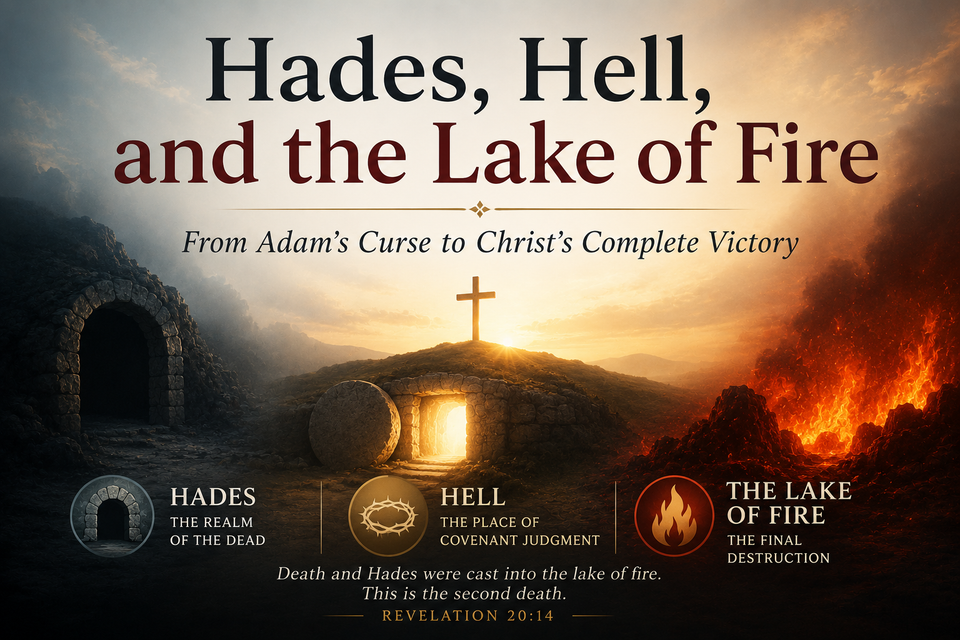
From Adam's Curse to Christ's Complete Victory
For generations, Christians have been taught to think of Hades as simply another name for an eternal hell, but the biblical story is far more layered than that. Hades existed within the unfinished world of the Old Covenant, while redemption was still moving toward its appointed fulfillment in Christ. Even the faithful dead could not yet enter into the fully unveiled presence of the Father because sin had not been finally removed, the perfect sacrifice had not yet been offered, and the true heavenly sanctuary had not yet been opened. The blood of bulls and goats could provide ceremonial cleansing and temporary covenantal covering, but it could never take away sin, perfect the conscience, or bring humanity all the way home.
For it is not possible that the blood of bulls and of goats should take away sins.(Hebrews 10:4)
This is why the Old Covenant system had to repeat its sacrifices year after year. Every sacrifice testified that the problem had not yet been finally resolved. Every priest who stood daily ministering declared by his continual service that the work was not finished. Every curtain, altar, sacrifice, and priestly ritual pointed beyond itself toward the coming of Christ.
And every priest standeth daily ministering and offering oftentimes the same sacrifices, which can never take away sins. (Hebrews 10:11)
The standing priest could never sit down because his work was never complete. Christ, however, offered one sacrifice for sins forever and sat down at the right hand of God because His sacrifice actually accomplished what the blood of animals could never do.
But this man, after he had offered one sacrifice for sins for ever, sat down on the right hand of God. (Hebrews 10:12)
Because the problem of sin had not yet been finally dealt with under the Old Covenant, the way into the immediate and unveiled presence of God remained restricted. The tabernacle and later the temple visibly represented this reality. The outer court, the Holy Place, the Most Holy Place, and especially the veil all testified that humanity did not yet possess unrestricted access into the presence of the Father.
The Holy Ghost this signifying, that the way into the holiest of all was not yet made manifest, while as the first tabernacle was yet standing. (Hebrews 9:8)
Notice the force of those words. The way into the holiest had not yet been made manifest. The veil was not merely an architectural feature. It was a covenantal testimony. It declared that access was not yet fully open, redemption had not yet reached its goal, and humanity was still waiting for the true High Priest to enter the true sanctuary with the true sacrifice.
This helps us understand the former purpose of Hades.
The word Hades has often been translated into English as “hell,” which has caused a great deal of confusion. In popular Christian thought, the word hell usually brings to mind a final place of eternal fiery punishment. However, the Greek word Hades does not necessarily carry that meaning. Hades is the Greek term commonly corresponding to the Hebrew word Sheol. Both words generally refer to the unseen realm of the dead, the grave, or the state and domain of departed souls.
For example, the King James Version translates Psalm 16 as saying:
For thou wilt not leave my soul in hell; neither wilt thou suffer thine Holy One to see corruption. (Psalm 16:10)
When Peter quotes this passage in Acts, the Greek word used is Hades.
Because thou wilt not leave my soul in hell, neither wilt thou suffer thine Holy One to see corruption. (Acts 2:27)
This does not mean that Christ was abandoned in a final place of eternal torment. It means that He entered death, descended into the realm of the dead, and was not left there. His body did not remain in the grave, and His soul was not held under the power of Hades. He rose victorious over death.
So, while some English translations use the word hell for Hades, Hades and what many Christians commonly mean by hell are not automatically identical. The confusion comes largely from the fact that older English translations sometimes used the single word hell to translate several different biblical terms.
Hades refers to the realm or domain of the dead.
Gehenna refers to the Valley of Hinnom outside Jerusalem and was used by Jesus as prophetic language of severe covenantal judgment.
Tartarus appears only once, in connection with rebellious spiritual beings being kept in chains of darkness.
The lake of fire in Revelation symbolizes final and irreversible judgment, even swallowing up Death and Hades themselves.
These terms are connected to death and judgment, but they are not simply different names for exactly the same thing.
This distinction becomes especially important in Revelation 20. If Hades were identical to the lake of fire, then it would make little sense for Hades itself to be cast into the lake of fire.
And death and hell were cast into the lake of fire. This is the second death.(Revelation 20:14)
The word translated as hell in that verse is Hades. Therefore, the verse literally presents Death and Hades as being cast into the lake of fire. Hades cannot simply be identical to the lake of fire because one is being cast into the other. The picture is not merely of people being punished. It is the destruction of Death and Hades themselves as ruling powers within the old Adamic and covenantal order.
Before the completion of redemption, Hades served as the realm of the dead. The righteous and the wicked both died, and both entered the unseen realm, although Scripture presents a distinction in their experience. Jesus’ account of the rich man and Lazarus in Luke 16 illustrates this distinction. Lazarus is comforted in Abraham’s bosom, while the rich man is in torment, and a great gulf exists between them.
Whether someone understands Luke 16 as a literal account, a parable, or a prophetic use of familiar imagery, the central point remains. There was a realm of the dead, and within that realm there was a distinction between comfort and judgment. The righteous were not abandoned by God, yet they were still waiting for the fulfillment of the promises. The wicked were not experiencing comfort, but judgment.
This means that Hades should not be imagined as one undifferentiated place where everyone experienced exactly the same condition. It was the realm of the dead, but Scripture could describe comfort for the faithful and anguish for the wicked within that realm.
The righteous dead waited because the promised Seed had not yet completed redemption. Abraham had received the promises, but he had not yet seen their historical fulfillment. David trusted God but still looked forward to the resurrection of the Messiah. The prophets saw the coming glory from a distance but did not receive the completed reality during their earthly lives.
These all died in faith, not having received the promises, but having seen them afar off, and were persuaded of them, and embraced them. (Hebrews 11:13)
Hebrews later explains that the Old Covenant faithful could not be made perfect apart from the New Covenant people.
God having provided some better thing for us, that they without us should not be made perfect. (Hebrews 11:40)
This does not mean that the Old Testament saints were faithless or rejected. It means they belonged to a redemptive story that had not yet reached its climax. They waited for Christ. They waited for the better sacrifice. They waited for the true High Priest. They waited for the heavenly sanctuary to be opened. They waited for the promises to be fulfilled in the Son.
Then Christ came.
By His incarnation, obedient life, death, resurrection, ascension, and priestly ministry, Jesus accomplished what the Old Covenant could only anticipate. He did not enter an earthly sanctuary made with hands. He entered the true heavenly sanctuary. He did not bring the blood of animals. He entered by His own blood. He did not obtain a temporary covering. He obtained eternal redemption.
Neither by the blood of goats and calves, but by his own blood he entered in once into the holy place, having obtained eternal redemption for us. (Hebrews 9:12)
The death of Christ dealt with sin. His resurrection defeated death. His ascension brought the true Man into the presence of the Father. His heavenly priesthood opened the way for those united to Him.
The tearing of the temple veil at the death of Christ prophetically declared that access had been opened through His flesh.
Jesus, when he had cried again with a loud voice, yielded up the ghost. And, behold, the veil of the temple was rent in twain from the top to the bottom.(Matthew 27:50–51)
The veil was torn from top to bottom, showing that this was the work of God, not man. Yet the earthly temple continued standing for another generation. The Old Covenant system continued outwardly functioning even though it had been made obsolete by Christ’s sacrifice.
From my 8th Day perspective, Christ accomplished redemption at the cross, resurrection, and ascension, while the old covenantal order reached its public and historical removal in AD 70. At that time, the earthly temple was destroyed, the sacrifices ceased, the Levitical priesthood lost its functioning sanctuary, and the old world that had resisted the reign of Christ was judged.
The destruction of the temple did not add something lacking to the blood of Christ. Rather, it publicly removed the obsolete covenantal system that had been left standing during the apostolic transition. The substance had come, and the shadow was finally taken away.
This is why Revelation speaks of Death and Hades delivering up the dead who were in them.
And the sea gave up the dead which were in it; and death and hell delivered up the dead which were in them: and they were judged every man according to their works. (Revelation 20:13)
Again, the word translated hell is Hades. Hades delivers up its dead. Then Hades itself is judged and cast into the lake of fire.
And death and hell were cast into the lake of fire. This is the second death. (Revelation 20:14)
John is showing the complete defeat of the powers associated with Adam’s reign. Death and Hades had exercised dominion over humanity because of sin. Adam brought sin into the world, and death entered through sin.
Wherefore, as by one man sin entered into the world, and death by sin. (Romans 5:12)
Death reigned from Adam onward, not merely as biological mortality, but as the covenantal condition of separation, condemnation, corruption, and exclusion from the unveiled presence of God.
Nevertheless death reigned from Adam to Moses. (Romans 5:14)
Christ came as the last Adam and the second Man to bring humanity out of Adam’s old creation and into the life of the new creation.
For as in Adam all die, even so in Christ shall all be made alive. (1 Corinthians 15:22)
The destruction of Death and Hades therefore does not mean that no human being would ever again experience physical death. People continued dying physically after AD 70, and they continue dying today. What ended was the covenantal reign and authority of Death and Hades over the people of God.
Death could no longer separate those in Christ from God. Hades could no longer function as a waiting realm for the righteous. The way into the Father’s presence had been opened. The true sanctuary had been entered. The better covenant had been established. The faithful no longer died under an unfinished redemptive order.
Paul had already anticipated the destruction of death.
The last enemy that shall be destroyed is death. (1 Corinthians 15:26)
And again:
Death is swallowed up in victory. (1 Corinthians 15:54)
And again:
O death, where is thy sting? O grave, where is thy victory? (1 Corinthians 15:55)
The word translated grave in that final verse is again Hades. Paul celebrates the loss of Hades’ victory. The realm of the dead no longer possesses the final word because Christ has risen and brought life and immortality to light through the gospel.
Who hath abolished death, and hath brought life and immortality to light through the gospel. (2 Timothy 1:10)
From an 8th Day perspective, the abolition of death is not the abolition of physical mortality. It is the abolition of death as a covenantal ruler. The believer may still lay down the physical body, but he does not descend into covenantal separation from God. He does not return to Adam’s condemnation. He does not wait outside the unveiled presence of the Father.
This explains the confidence with which Paul could speak about departing the body.
We are confident, I say, and willing rather to be absent from the body, and to be present with the Lord. (2 Corinthians 5:8)
Paul does not say, “Absent from the body and waiting in Hades.”
He does not say, “Absent from the body and placed in Abraham’s bosom until a future cosmic resurrection thousands of years later.”
He says that to be absent from the body is to be present with the Lord.
Likewise, Paul writes:
For I am in a strait betwixt two, having a desire to depart, and to be with Christ; which is far better. (Philippians 1:23)
He does not desire to depart and enter a temporary holding place. He desires to depart and be with Christ. This language reflects a redemptive transition. The destination of the believer is no longer described as waiting in Hades but as being with the Lord.
Christ Himself declared that He was going to prepare a place for His people in the Father’s house.
In my Father's house are many mansions: if it were not so, I would have told you. I go to prepare a place for you. (John 14:2)
This preparation was not about constructing physical buildings in heaven. Christ prepared the way into the Father’s presence through His death, resurrection, ascension, and priestly ministry. He opened what had formerly been closed. He brought humanity into the place He occupied with the Father.
The true issue throughout redemption was always access to God. Adam was driven from Eden. Cherubim guarded the way to the tree of life. Israel stood at a distance from Sinai. The people remained outside while the priests ministered. The priests remained outside the Most Holy Place while only the high priest entered once a year. The veil declared separation. Hades testified that the dead were still waiting.
Christ reversed the entire order.
The veil was torn.
The heavenly sanctuary was opened.
The better covenant was established.
The saints came to Mount Zion.
Death lost its sting.
Hades lost its victory.
This is why Hebrews does not tell New Covenant believers that they are still waiting to come to the heavenly city.
But ye are come unto mount Sion, and unto the city of the living God, the heavenly Jerusalem. (Hebrews 12:22)
The tense is important. “Ye are come.” The writer does not say, “One day you may come.” He declares that they had already approached heavenly Zion through Christ. The New Covenant opened access to a present spiritual reality that the Old Covenant saints had awaited.
This also explains why Hebrews repeatedly speaks of better things.
A better hope.
A better covenant.
Better promises.
A better sacrifice.
A better country.
A better resurrection.
These things are better because they bring humanity into the finished reality that the Old Covenant could only portray through shadows.
Hades belonged to the age of waiting.
The New Covenant belongs to the age of access.
Hades belonged to the order in which the veil still stood.
The New Covenant belongs to the order in which the veil has been removed.
Hades belonged to the world in which redemption was promised but not yet completed.
The New Covenant belongs to the world in which Christ has obtained eternal redemption and brought His people into the presence of the Father.
There is therefore a real difference between Hades and what many people mean when they say hell. Hades was the realm of the dead, the temporary unseen abode associated with the unfinished redemptive order. Gehenna was Jesus’ prophetic language of covenantal judgment, especially directed toward the generation that would experience the destruction of Jerusalem. The lake of fire represents final destruction and irreversible divine judgment. Hades itself was cast into the lake of fire, showing that it was not the eternal final destination of humanity but a temporary power that would itself come to an end.
The popular doctrine that every person who dies without Christ immediately enters the same place called hell and remains there endlessly is not established merely by pointing to the word Hades. The biblical words must be examined in their own contexts. Hades cannot automatically be made identical to Gehenna, and neither should automatically be treated as identical to the lake of fire.
This does not remove divine judgment from Scripture. It clarifies the language of judgment. The wicked faced real judgment. Covenant breakers faced real destruction. Those who resisted Christ faced the consequences of remaining in Adam. But the biblical doctrine of judgment should not be constructed by collapsing every word into one English term and then importing later theological assumptions back into the text.
From my 8th Day perspective, Hades had a specific purpose within the unfolding plan of redemption. It held the dead while the promises awaited fulfillment, while the sacrifice awaited offering, while the sanctuary awaited opening, while the veil still stood, and while the Old Covenant remained in operation.
Once Christ completed His redemptive mission and the Old Covenant order passed away, Hades no longer had a purpose for the righteous. The faithful no longer waited in Abraham’s bosom. They entered the presence of the Lord. The Father’s house was open. Heavenly Zion had been reached. The better country had arrived in Christ.
Hades can therefore be compared to the veil of the temple. Both were temporary. Both testified that something remained unfinished. Both belonged to the Old Covenant order. Both existed because humanity had not yet been brought into fully unveiled communion with the Father. And both lost their purpose when Christ completed the work of redemption.
The Law served until Christ.
The sacrifices served until the true Lamb was offered.
The priesthood served until the true High Priest entered heaven.
The temple served until the true dwelling place of God was revealed in Christ and His people.
The veil served until access was opened.
Hades served until death was defeated and the faithful could enter the presence of the Lord.
Christ fulfilled them all.
So the former purpose of Hades was to serve as the temporary realm of the dead under the Old Covenant economy while humanity awaited the completion of redemption. It was not God’s eternal purpose for His children, nor was it the believer’s final home. It belonged to the age of promise, shadow, distance, and waiting.
Once Christ obtained eternal redemption, opened the heavenly sanctuary, defeated Adamic death, and brought the Old Covenant age to its conclusion, Death and Hades surrendered their dead and were themselves cast into the lake of fire. Their covenantal authority ended because their purpose had been fulfilled.
Hades was not humanity’s eternal destination. It was redemption’s waiting room. Once Christ completed the work, removed the old covenantal order, and opened the Father’s house, the waiting room closed because the sons and daughters of God were finally brought home.
Please feel free to comment and enter the discussion. Please be respectful.
If these messages have encouraged you, like, comment and subscribe. Please consider planting a seed. Your generosity helps continue this work and creates opportunities for others to grow and strengthen their faith.

Member discussion